

NZ School Attendance: Rules, Absences & Regular Attendance
Learn how school attendance works in New Zealand, including attendance requirements, regular attendance, absences, parent responsibilities, support options, and what to do when attendance becomes a concern.
The Ministry of Education defines regular attendance as being present for more than 90% of the term.
Important: 90% is the current regular-attendance benchmark. It is not a standalone legal minimum attendance percentage.
How School Attendance Works in New Zealand
School attendance is an important part of a student’s education in New Zealand. Students are expected to attend school regularly and take part in learning whenever their school is open for instruction.
The Ministry of Education currently describes regular attendance as being present for more than 90% of the term. This means attendance information is more than a simple count of days missed. Schools also consider the circumstances of absences and work with families when attendance becomes a concern.
Regular Attendance
More than 90% attendance for the term is the Ministry’s current definition of regular attendance.
Attendance Matters
Students are expected to attend school every day it is open unless there is a valid reason for being away.
Responsibility
Students, parents, schools and wider support services all have roles in helping students attend regularly.
Important distinction: The 90% figure describes the Ministry’s current definition of regular attendance. It should not be presented as a legal rule saying students may legally miss 10% of school.
Table of Contents
NZ School Attendance Rules & Legal Requirements
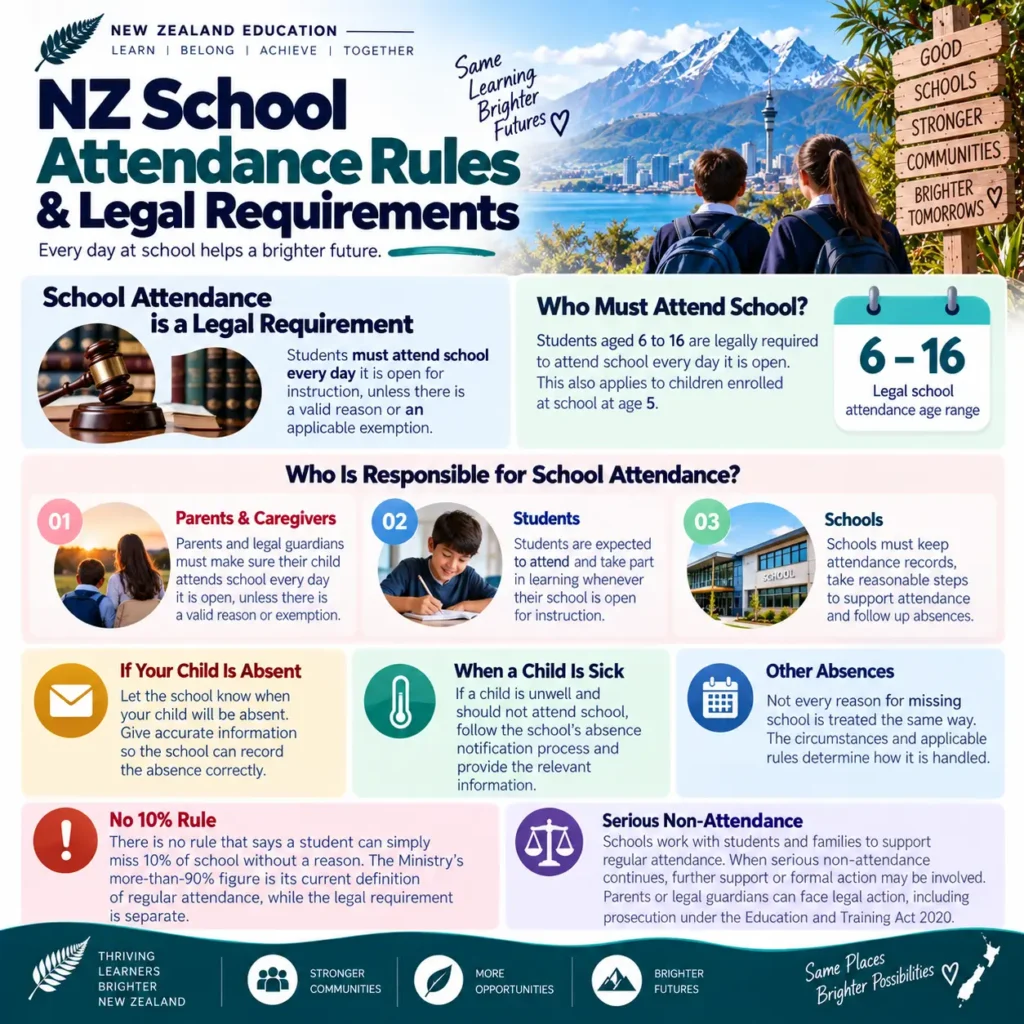
School attendance is a legal requirement in New Zealand. Students are expected to attend school every day it is open for instruction, unless there is a valid reason or an applicable exemption.
The Ministry of Education states that parents and legal guardians must make sure their child attends school every day it is open until the child is at least 16. This also applies to enrolled 5-year-olds.
Who Must Attend School?
Students aged 6 to 16 are legally required to attend school every day it is open. The requirement also applies to children who are enrolled at school at age 5.
Who Is Responsible for School Attendance?
Parents & Caregivers
Parents and legal guardians are responsible for making sure their child attends school every day it is open, unless an absence is covered by a valid reason or exemption.
Students
Students are expected to attend and take part in learning whenever their school is open for instruction.
Schools
Schools must take all reasonable steps to support attendance, keep attendance records and have a process for notifying and following up absences.
What Should Parents Do When a Child Is Absent?
Parents and caregivers should let the school know when their child will be absent. Schools have an absence notification process and may contact a parent or caregiver when a student is absent without an explanation.
Giving the school accurate information helps it record the absence correctly and understand whether further support may be needed.
When a Child Is Sick
If a child is unwell and should not attend school, parents should follow the school’s absence notification process and provide the relevant information.
Other Absences
Not every reason for missing school is automatically treated in the same way. The circumstances of the absence and applicable rules determine how it is handled.
Important: There is no rule that says a student can simply miss 10% of school without a reason. The Ministry’s more-than-90% figure is its current definition of regular attendance, while the legal attendance requirement is separate.
What Happens With Serious Non-Attendance?
Schools are expected to work with students and families to support regular attendance. When serious non-attendance continues, further attendance support or other formal action may become involved.
The Ministry states that failure by parents or legal guardians to meet attendance obligations can lead to legal action, including prosecution under the Education and Training Act 2020.
Want to Understand Attendance Codes?
Our separate guide explains the current 15 NZ school attendance codes, including present, justified and unjustified absence codes.
VIEW ATTENDANCE CODESWhat Counts as Regular Attendance?
The Ministry of Education defines regular school attendance as being present for more than 90% of the term. This measure looks at a student’s attendance across the whole term rather than on one particular school day.
The 90% figure is used to describe regular attendance. It does not mean that students have an automatic right to miss 10% of school without a valid reason.
The Ministry’s Regular Attendance Measure
A student is counted as having regular attendance when they are present for more than 90% of the term.
New Zealand’s Four Attendance Categories
The Ministry groups students into four categories based on the percentage of the term they attended.
A Simple Example
Imagine a student is present for 91% of the school term. Under the Ministry’s attendance categories, that student is counted as having regular attendance.
If the student’s attendance falls to 90% or below, the student is no longer in the regular-attendance category for that term.
Daily Attendance vs Regular Attendance
Looks at individual days
Daily attendance provides a faster picture of how many students were present on a particular school day.
Looks at the whole term
Regular attendance summarises an individual student’s attendance across the whole term using their attendance records.
Important distinction: Regular attendance is a term-based measurement used by the Ministry. It should not be interpreted as a legal allowance that permits a student to miss up to 10% of school without a valid reason.
How NZ School Attendance Is Calculated
School attendance is recorded during the time a student is expected to be at school. Attendance information can then be used to calculate the percentage of time a student was present during a term.
The Ministry uses attendance data to measure regular attendance and identify patterns of absence. Schools also use attendance information when responding to attendance concerns.
Basic Attendance Percentage Formula
The Ministry’s attendance data uses the time students were expected to be in class. This allows attendance information to be compared across different class lengths and school types.
Simple Attendance Example
Units of school time the student was expected to attend.
Units of the expected school time that the student attended.
92 ÷ 100 × 100 = 92% attendance.
Attendance Is Recorded in Half-Day Units
New Zealand attendance rules use half-day attendance records. A half-day is a period of at least 2 hours during which a school is open for instruction.
Secondary schools can also record attendance for individual periods. Their student management system can use those records to calculate the student’s attendance.
Why Can Attendance Percentages Look Different?
Different Time Periods
A term attendance percentage and a year-to-date percentage measure different periods, so they should not be treated as the same figure.
Half-Day Records
Attendance records are based on half-day units, while some schools also record secondary attendance by individual periods.
Recorded Absence
Different absence reasons are recorded using the Ministry’s current attendance system and codes.
Calculate Your School Attendance
Use our NZ Attendance Calculator to work out attendance percentage, days attended, absences and the number of days needed to reach a selected attendance level.
Important: Attendance percentages are based on official school attendance records. Your school’s student management system may display figures differently depending on the reporting period and how attendance data is presented.
Absences, Illness & Holidays During Term
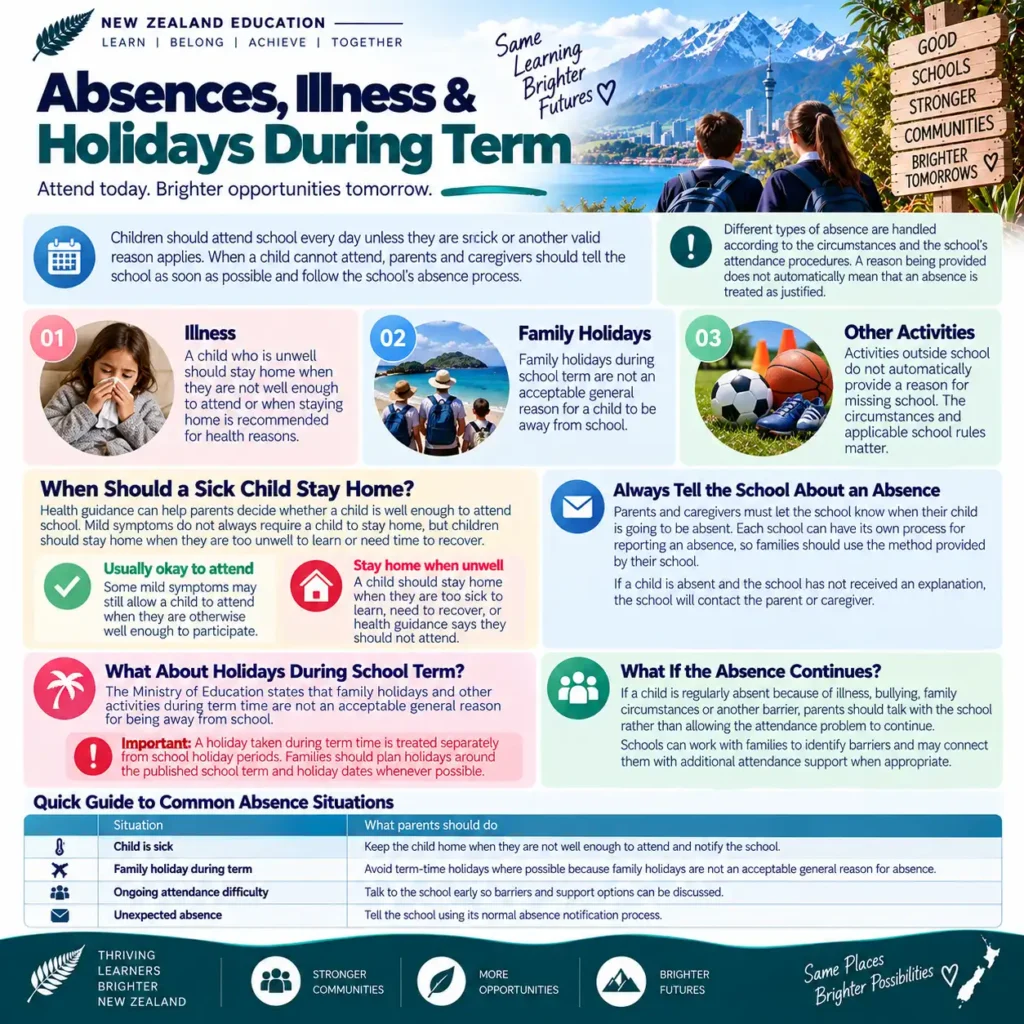
Children should attend school every day unless they are sick or another valid reason applies. When a child cannot attend, parents and caregivers should tell the school as soon as possible and follow the school’s absence process.
Different types of absence are handled according to the circumstances and the school’s attendance procedures. A reason being provided does not automatically mean that an absence is treated as justified.
Illness
A child who is unwell should stay home when they are not well enough to attend or when staying home is recommended for health reasons.
Family Holidays
Family holidays during school term are not an acceptable general reason for a child to be away from school.
Other Activities
Activities outside school do not automatically provide a reason for missing school. The circumstances and applicable school rules matter.
When Should a Sick Child Stay Home?
Health guidance can help parents decide whether a child is well enough to attend school. Mild symptoms do not always require a child to stay home, but children should stay home when they are too unwell to learn or need time to recover.
Some mild symptoms may still allow a child to attend when they are otherwise well enough to participate.
A child should stay home when they are too sick to learn, need to recover, or health guidance says they should not attend.
Always Tell the School About an Absence
Parents and caregivers must let the school know when their child is going to be absent. Each school can have its own process for reporting an absence, so families should use the method provided by their school.
If a child is absent and the school has not received an explanation, the school will contact the parent or caregiver.
What About Holidays During School Term?
The Ministry of Education states that family holidays and other activities during term time are not an acceptable general reason for being away from school.
Important: A holiday taken during term time is treated separately from school holiday periods. Families should plan holidays around the published school term and holiday dates whenever possible.
What If the Absence Continues?
If a child is regularly absent because of illness, bullying, family circumstances or another barrier, parents should talk with the school rather than allowing the attendance problem to continue without communication.
Schools can work with families to identify barriers and may connect them with additional attendance support when appropriate.
Quick Guide to Common Absence Situations
Need the Attendance Code Details?
See our separate guide to the current 15 NZ school attendance codes and how schools use them.
What Schools Do When Attendance Falls
When a student’s absences begin to increase, schools are expected to identify the problem and respond rather than simply record the missed days.
Since Term 1 2026, state and state-integrated schools have been required to use an Attendance Management Plan. The plan sets out how the school will identify absences, respond to attendance concerns and support students and families.
Attendance Management Plans
An Attendance Management Plan, or AMP, gives each school a structured approach for responding to student absence.
Identify patterns and increasing absence.
Look at barriers and possible reasons for absence.
Take appropriate action to support attendance.
Attendance Response Thresholds
The current Stepped Attendance Response framework uses three absence thresholds within a school term: 5 days, 10 days and 15 days. The threshold count resets at the end of each term.
Days of absence
The school begins an appropriate response to understand the absence and support a return to regular attendance.
Days of absence
The school reviews the situation and may use additional strategies or support to address barriers.
Days of absence
More intensive support may be considered, including involvement of an attendance service when appropriate.
Important: These thresholds are response points within the STAR and school attendance management process. They are not permission for a student to miss 5, 10 or 15 days of school.
What May Happen When Absence Increases?
Contact the Family
The school may communicate with parents or caregivers to understand why the student is absent and discuss the next steps.
Identify Barriers
Schools can consider barriers such as illness, bullying, family circumstances or other factors affecting attendance.
Create Support
The school may develop an individual response or support plan with the student and family.
Seek Additional Support
When school-based efforts are not enough, an attendance service may become involved for students with significant attendance concerns.
Attendance Support Is a Shared Responsibility
The Ministry’s STAR framework treats attendance as a shared priority for students, families, schools and the Ministry. Parents and caregivers are expected to work with schools and engage with support offered to help a child return to regular attendance.
When Can Extra Attendance Support Be Involved?
The Attendance Service works with schools and families when students have ongoing, significant or complex attendance concerns that have not improved through school-based approaches alone.
Schools may request support when additional help is appropriate. The service can work with students and families to identify and address barriers to attendance.
The Goal Is to Improve Attendance
An attendance concern does not automatically mean that a family has done something wrong. The school response is designed to identify the reason for absence, address barriers and help the student return to regular attendance.
Attendance Management Plans & STAR
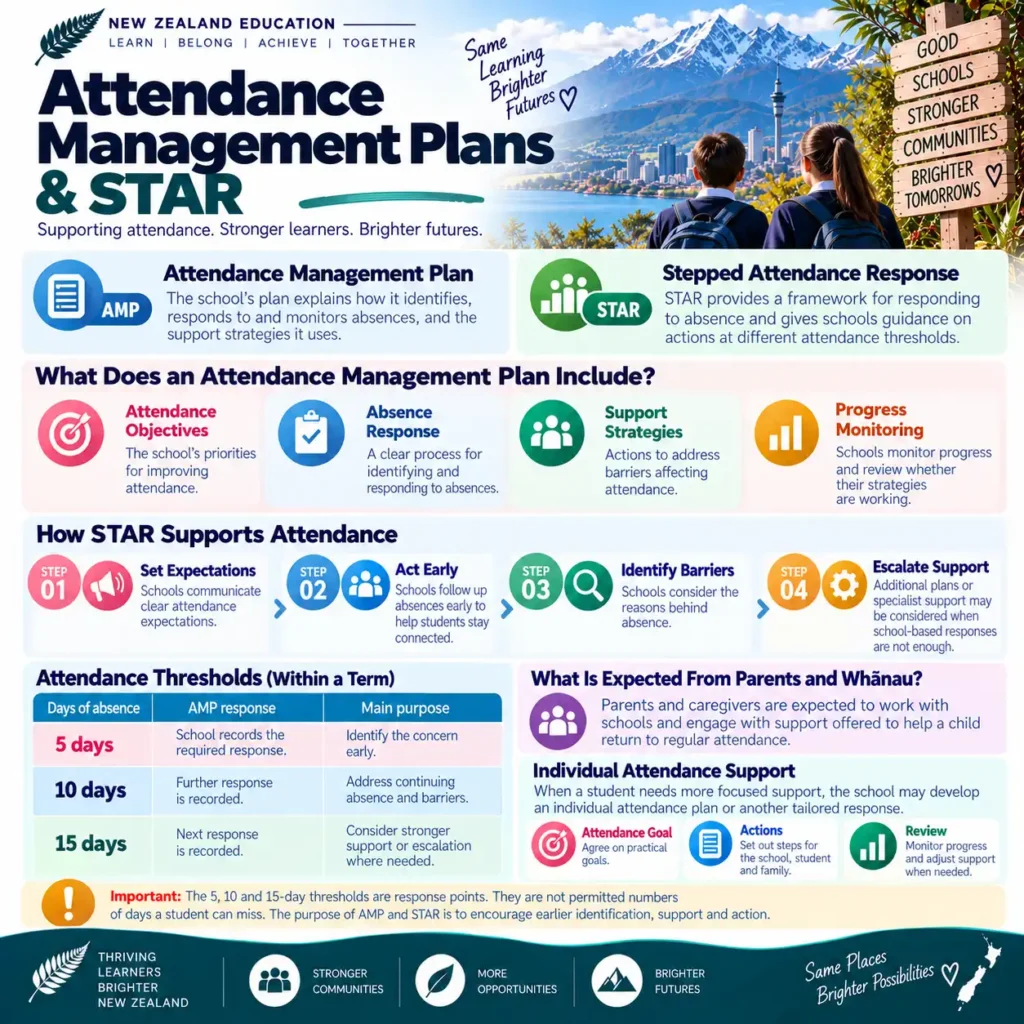
New Zealand schools use an Attendance Management Plan (AMP) to set out how they identify, respond to and monitor student absences. The plan gives schools a clear process for supporting students when attendance becomes a concern.
Since the beginning of Term 1 2026, all state and state-integrated schools have been required to have an AMP. Schools must have regard to the Ministry of Education’s Stepped Attendance Response (STAR) when developing their plans.
Attendance Management Plan
The school’s own plan explains its attendance objectives, response processes, support strategies, monitoring methods and actions at different absence thresholds.
Stepped Attendance Response
STAR provides a framework for responding to absence and gives schools guidance on actions at different attendance thresholds.
What Does an Attendance Management Plan Include?
Attendance Objectives
The school’s objectives and priorities for improving attendance.
Absence Response
A clear process for identifying and responding to student absences.
Support Strategies
Actions to identify and address barriers affecting attendance.
Progress Monitoring
Schools monitor attendance progress and review whether their strategies are working.
How STAR Supports Attendance
Set Expectations
Schools communicate clear attendance expectations and procedures.
Act Early
Schools follow up absences early to help students stay connected with learning.
Identify Barriers
Schools consider the reasons behind absence and whether those reasons may continue.
Escalate Support
Additional plans, services or specialist support may be considered when school-based responses are not enough.
What Happens at Attendance Thresholds?
Schools set response actions in their AMP when a student reaches an absence threshold. The current Ministry framework uses 5, 10 and 15 days of absence within a term. The threshold count resets at the end of each term.
What Is Expected From Parents and Whānau?
Parents and caregivers are expected to work with schools and engage with support offered to help a child return to regular attendance.
Good communication can help the school understand the reasons for absence and choose an appropriate response.
Individual Attendance Support
When a student’s attendance needs more focused support, the school may develop an individual attendance plan or another tailored response.
Agree on practical attendance goals.
Set out steps for the school, student and family.
Monitor progress and adjust support when needed.
Important: The 5, 10 and 15-day thresholds are response points. They are not permitted numbers of days a student can miss. The purpose of AMP and STAR is to encourage earlier identification, support and action when attendance starts to fall.
Attendance Support & Attendance Services
Some students need more help to return to regular school attendance. Schools can work with students and families to understand the barriers affecting attendance and decide what support may be appropriate.
When school-based efforts are not enough, an Attendance Service can provide additional support for students with significant attendance concerns.
Extra Support for Significant Attendance Concerns
The Attendance Service works with schools, students and families to help address barriers that are affecting attendance.
When Might Additional Attendance Support Be Needed?
Additional support may be considered when a student’s attendance remains a concern despite efforts by the school and family.
Ongoing Absence
The student continues to miss school regularly and attendance does not improve through normal school responses.
Complex Barriers
Several factors may be affecting attendance and require more coordinated support.
School Support Is Not Enough
Additional help may be appropriate after the school has tried reasonable attendance support.
What Can an Attendance Service Do?
Understand Barriers
Work with the student and family to understand what is making regular attendance difficult.
Create a Support Approach
Help identify practical steps that can support a return to school.
Work With the School
Coordinate with the school and family around attendance goals and support.
Follow Progress
Continue working with the student and family as attendance improves or further support is needed.
Common Barriers That Can Affect Attendance
Attendance difficulties can have different causes. Understanding the barrier can help the school and family decide what type of support may be useful.
Ongoing health difficulties can make regular attendance harder.
Concerns about school safety or bullying may affect a student’s willingness to attend.
Changes or difficulties at home can sometimes affect attendance.
Each student’s circumstances are different and may require a different response.
What Parents and Caregivers Can Do
If a child is struggling with regular attendance, talking to the school early can make it easier to identify the problem and discuss possible support.
Explain what is affecting your child’s attendance.
Ask what school-based options may be available.
Keep communication open while attendance improves.
How Does Attendance Service Support Start?
The school can consider referring a student for Attendance Service support when additional help is needed. The service then works with the relevant people to understand the situation and support improved attendance.
The exact support depends on the student’s circumstances. There is no single solution that applies to every attendance problem.
When a Child Cannot Attend Full School Hours
Some students may need a temporary reduced-hours arrangement because of specific wellbeing or other circumstances. These arrangements have their own requirements and should be discussed with the school.
LEARN ABOUT REDUCED-HOURS PLANSImportant: Attendance support is intended to help address barriers and improve attendance. It does not replace the legal requirement for eligible students to attend school.
What to Do If Your Child Is Struggling With Attendance
If your child is regularly missing school, it is usually better to talk with the school early rather than waiting for the attendance problem to become more serious.
Attendance difficulties can have different causes. The first step is to understand what is making school attendance difficult and work with the school on practical ways to address it.
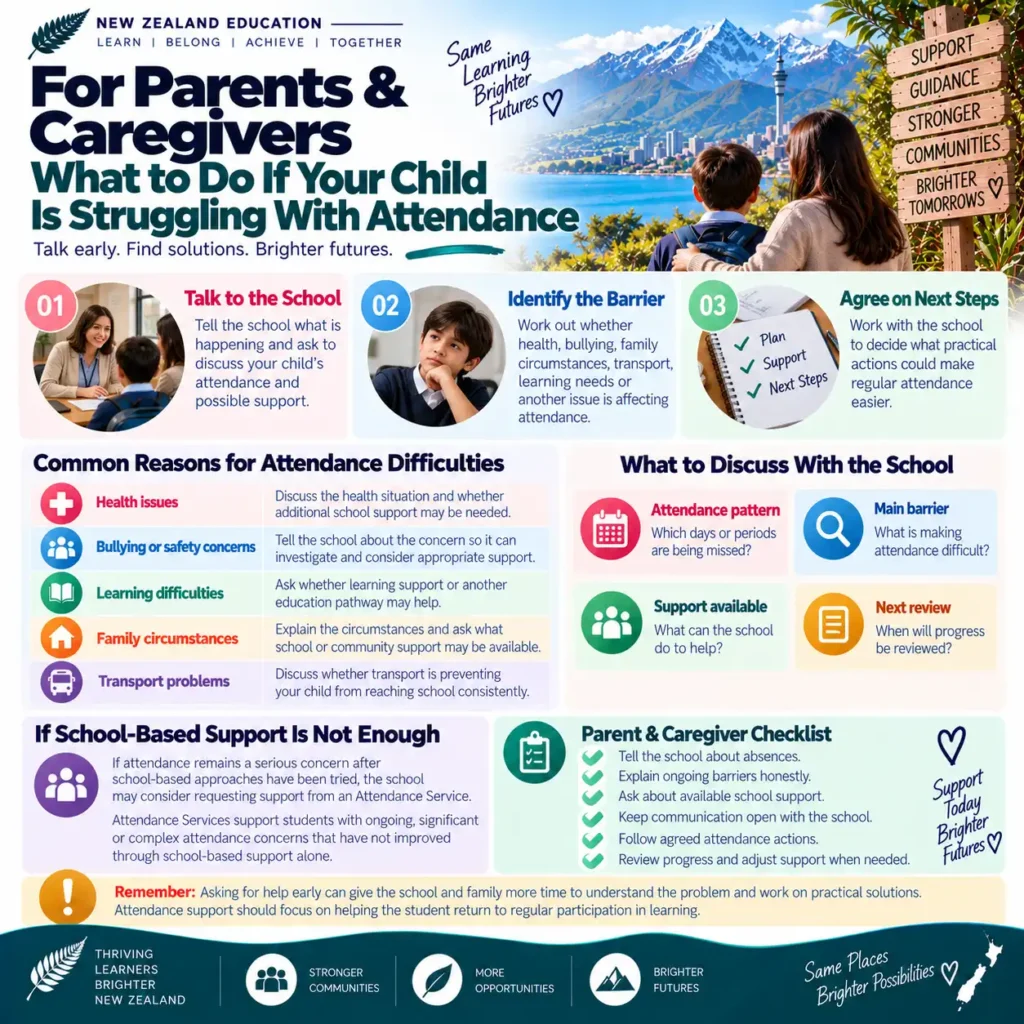
Talk to the School
Tell the school what is happening and ask to discuss your child’s attendance and possible support.
Identify the Barrier
Work out whether health, bullying, family circumstances, transport, learning needs or another issue is affecting attendance.
Agree on Next Steps
Work with the school to decide what practical actions could make regular attendance easier.
Start by Understanding the Problem
The reason behind an absence matters. A student may need a different type of support depending on what is affecting their ability to attend.
What to Discuss in a Meeting With the School
A useful conversation should focus on the student’s circumstances and practical steps that could improve attendance.
Which days or periods are being missed?
What is making attendance difficult?
What can the school do to help?
When will progress be reviewed?
If School-Based Support Is Not Enough
If attendance remains a serious concern after school-based approaches have been tried, the school may consider requesting support from an Attendance Service.
Attendance Services are designed to support students with ongoing, significant or complex attendance concerns that have not improved through school-based approaches alone.
Parent & Caregiver Checklist
Remember: Asking for help early can give the school and family more time to understand the problem and work on practical solutions. Attendance support should focus on helping the student return to regular participation in learning.
Attendance vs Absence: What’s the Difference?
Attendance and absence describe opposite sides of a student’s school participation. Attendance measures when a student is present, while absence records periods when the student is not present when expected.
Understanding the difference makes it easier to read school attendance records and understand how attendance percentages are calculated.
Student Is Present
Attendance is recorded when the student is present during the time they are expected to attend school.
A student attends the school day and participates in their scheduled learning.
Student Is Not Present
An absence occurs when a student is not present during expected school time.
A student does not attend school for part or all of the time they were expected to be present.
How Absences Affect Attendance Percentage
When a student misses expected school time, the amount of attendance recorded for that period decreases. Over a term, repeated absences can therefore reduce the student’s overall attendance percentage.
time present
attendance percentage
absences
Not All Absences Are Treated the Same Way
Schools record the circumstances of absences using the Ministry’s attendance system. The reason for an absence can affect how the absence is categorised and reported.
Illness
Health-related absence is recorded according to the applicable attendance guidance.
Approved Reasons
Some absences may have an approved reason under the school’s attendance rules.
Unapproved Reasons
Some reasons may not meet the school’s requirements for an approved absence.
Want to See the Current Attendance Codes?
Our separate NZ School Attendance Codes guide explains the current 15-code system, including present, justified and unjustified attendance categories.
VIEW ATTENDANCE CODESWhy Your School Attendance Record Matters
Attendance records help schools understand whether students are attending regularly and whether additional support may be needed.
If you think an attendance record is incorrect, contact the school and ask them to explain the entry or review the record.
Key takeaway: Attendance percentage shows how much expected school time a student attended. Absence records show the periods when the student was not present. Both are important parts of a student’s attendance record.
NZ School Attendance FAQs
Here are answers to common questions about New Zealand school attendance, absences, regular attendance and attendance support.
Is school attendance compulsory in New Zealand?
What is considered regular school attendance in NZ?
Does 90% attendance mean a student can legally miss 10% of school?
What should parents do if their child is absent?
Can a child stay home when they are sick?
Are family holidays during school term allowed?
What happens when a student has too many absences?
What are the 5, 10 and 15-day attendance thresholds?
What is an Attendance Management Plan?
What is STAR in school attendance?
What if my child is struggling to attend school?
What is the Attendance Service?
Where can I find NZ school attendance codes?
Can I calculate my child’s attendance percentage?
What should I do if I think an attendance record is incorrect?
Note: Attendance requirements and Ministry guidance can change. For important attendance matters, families should also check current information from their school and the New Zealand Ministry of Education.
Understanding NZ School Attendance
Regular school attendance is an important part of a student’s education. New Zealand’s attendance system combines legal attendance requirements, school attendance records, regular-attendance measures and support for students experiencing barriers.
If attendance becomes difficult, talking with the school early can help identify the reason for absence and find appropriate support.
Attend Regularly
The Ministry defines regular attendance as being present for more than 90% of the term.
Communicate
Parents and caregivers should notify the school when a child is absent.
Ask for Support
Schools and attendance services can help address barriers affecting regular attendance.