
NCEA Explained: Levels, Credits & Qualifications
Learn how NCEA works in New Zealand, including levels, credits, assessments, certificates and pathways after secondary school.
What Is NCEA?
NCEA stands for the National Certificate of Educational Achievement. It is the main secondary school qualification in New Zealand. NCEA is made up of three qualification levels: Level 1, Level 2 and Level 3. Students usually work through these levels during Years 11 to 13. :contentReference[oaicite:0]{index=0}
NCEA uses standards and credits to recognise student achievement. When a student achieves a standard, they earn credits. The credits can then contribute towards an NCEA qualification. Students can gain credits through different subjects and can study standards at different levels where their programme allows it. :contentReference[oaicite:1]{index=1}
NCEA can support pathways into tertiary education, training and employment. University Entrance is a separate award with its own requirements. :contentReference[oaicite:2]{index=2}
1, 2 & 3
NCEA has three qualification levels.
Standards
Achieved standards can give students credits.
Study & Work
NCEA can support further study, training and employment.
Table of Contents
How Does NCEA Work?
NCEA is based on standards and credits. A standard describes what a learner needs to know or do. When a learner successfully meets the requirements of a standard, they can earn credits towards an NCEA qualification. Students can earn credits through both internal and external assessment. :contentReference[oaicite:0]{index=0}
Under the current NCEA structure, Levels 1, 2 and 3 each have a 60-credit qualification requirement. A separate 20-credit literacy, numeracy, te reo matatini and pāngarau co-requisite must also be met for an NCEA qualification. This co-requisite is counted separately from the 60 certificate credits. :contentReference[oaicite:1]{index=1}
Choose Standards
Students study courses that contain standards at appropriate NCEA levels.
Complete Assessment
Standards can be assessed through internal or external assessment.
Earn Credits
Achieved standards give students credits that can contribute towards their qualification.
Build a Qualification
Students combine the required credits and meet the co-requisite to gain NCEA.
A Useful Point to Remember
NCEA is not based on one final examination alone. Students can build credits through different standards and can work towards a qualification over more than one year. Credits can also be gained at different levels when a student’s programme includes multi-level study. :contentReference[oaicite:2]{index=2}
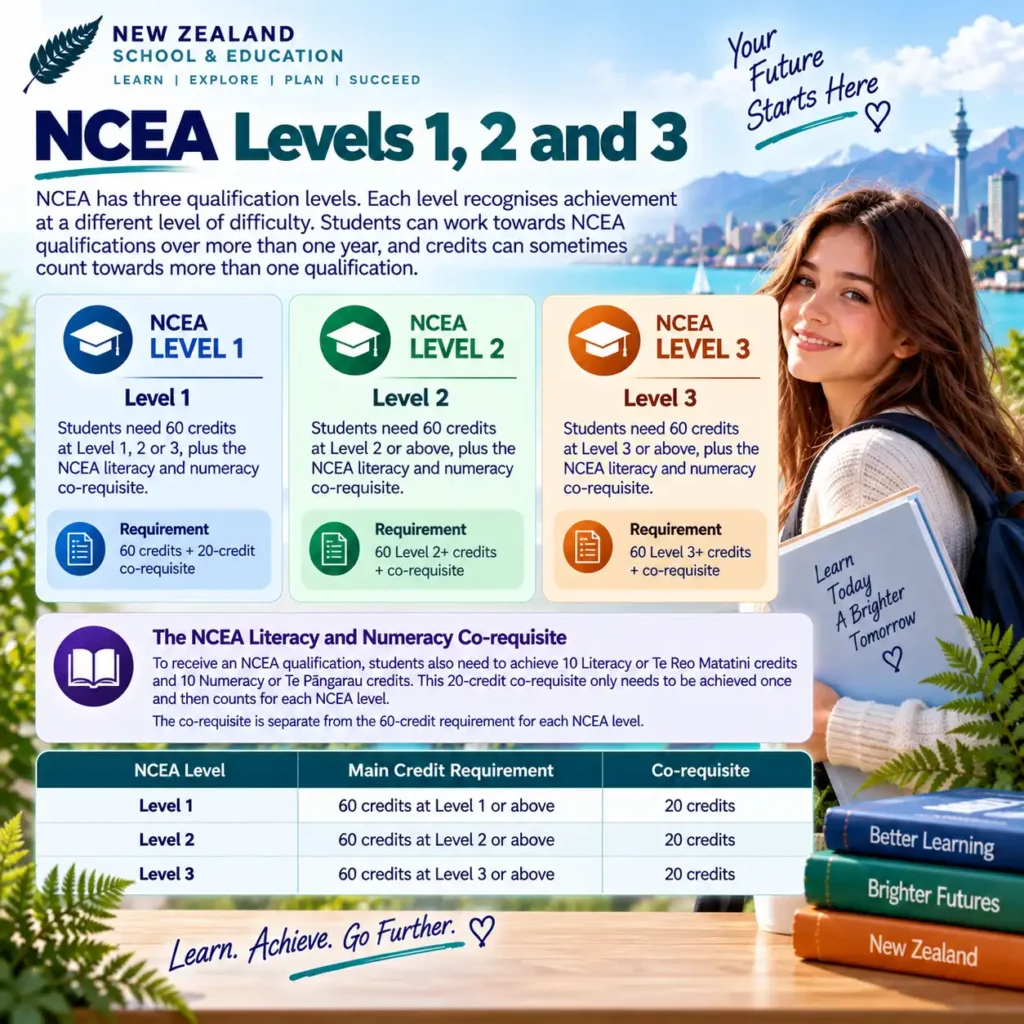
NCEA Levels 1, 2 and 3
NCEA has three qualification levels. Each level recognises achievement at a different level of difficulty. Students can work towards NCEA qualifications over more than one year, and credits can sometimes count towards more than one qualification. :contentReference[oaicite:1]{index=1}
Level 1
Students need 60 credits at Level 1, 2 or 3, plus the NCEA literacy and numeracy co-requisite.
60 credits + 20-credit co-requisite
Level 2
Students need 60 credits at Level 2 or above, plus the NCEA literacy and numeracy co-requisite.
60 Level 2+ credits + co-requisite
Level 3
Students need 60 credits at Level 3 or above, plus the NCEA literacy and numeracy co-requisite.
60 Level 3+ credits + co-requisite
The NCEA Literacy and Numeracy Co-requisite
To receive an NCEA qualification, students also need to achieve 10 Literacy or Te Reo Matatini credits and 10 Numeracy or Te Pāngarau credits. This 20-credit co-requisite only needs to be achieved once and then counts for each NCEA level. :contentReference[oaicite:2]{index=2}
The co-requisite is separate from the 60-credit requirement for each NCEA level. :contentReference[oaicite:3]{index=3}
NCEA Credits and Assessment
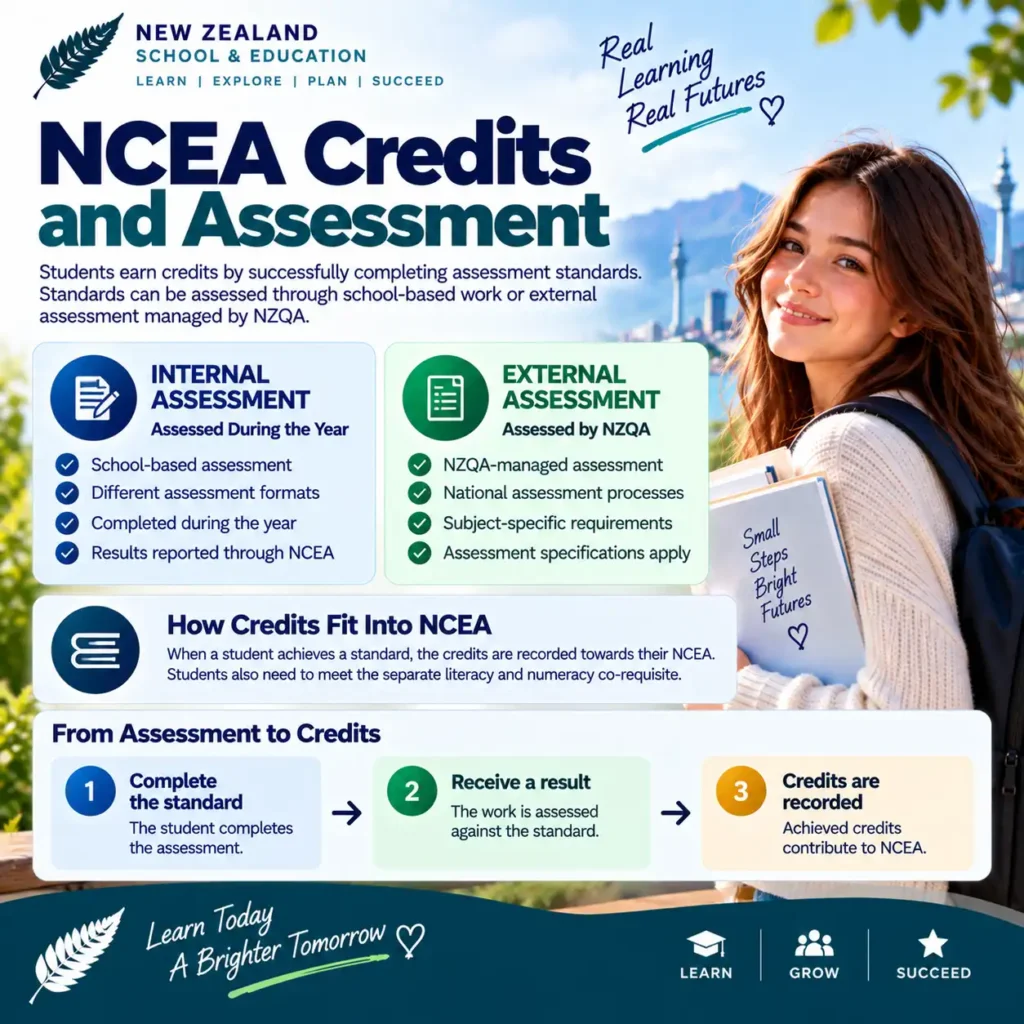
Credits are an important part of NCEA. Students earn credits by successfully completing assessment standards. These standards can be assessed through work completed during the year or through external assessment managed by NZQA.
Schools decide how many standards are included in their courses and how students will be assessed. The exact standards and assessment methods therefore depend on the subject and the student’s programme.
Assessed During the Year
Internal assessment is completed during the school year. Depending on the standard, students may demonstrate their learning through different types of work or assessment activities.
- School-based assessment
- Different assessment formats
- Assessment completed during the year
- Results reported through the NCEA system
Assessed by NZQA
External assessment is managed by NZQA. Many external assessments take place during the national assessment period, while some standards use other assessment formats and schedules.
- NZQA-managed assessment
- National assessment processes
- Subject-specific requirements
- Assessment specifications apply
How Credits Fit Into NCEA
When a student achieves an assessment standard, the associated credits are recorded towards their NCEA results. Students work towards the credit requirements for their qualification and also need to meet the separate NCEA literacy and numeracy co-requisite.
Credits are not simply a percentage score. They represent achievement of specific standards, so students should check the standards included in their subjects and courses.
From Assessment to Credits
The student completes the required assessment activity.
The work is assessed against the requirements of the standard.
Achieved credits can contribute towards the student’s NCEA.
Assessment Requirements Can Vary
NCEA assessment is subject-specific. Students should check their school’s course information and the relevant NZQA assessment specifications for the standards they are taking.
NCEA Subjects and Courses
NCEA students can choose from a wide range of subjects and learning areas. The subjects available depend on the school, year level, timetable and courses offered. NZQA provides assessment information and resources for NCEA subjects and learning areas.
Choosing subjects becomes more important as students move through secondary school. NZQA recommends considering future study, career interests, strengths and subjects that students enjoy. Some tertiary courses may also require particular subjects or standards. :contentReference[oaicite:1]{index=1}
English
Reading, writing, language and communication skills.
Mathematics & Statistics
Mathematical and statistical learning across different courses.
Science
Science courses can include different specialist areas.
Social Sciences
Areas such as history, geography, economics and social studies.
Languages
Students may study English, te reo Māori and other languages.
Arts & Technology
Creative, practical and technology-focused learning areas.
Other NCEA Learning Areas
NZQA’s NCEA resources also cover specialist subjects and learning areas such as Accounting, Biology, Chemistry, Physics, Business Studies, Calculus, Geography, Health Education, Music, Drama, Psychology, Technology, Digital Technologies and others. :contentReference[oaicite:2]{index=2}
How Should Students Choose NCEA Subjects?
Students should consider their interests, strengths and future plans. At higher year levels, it can also help to check the subject requirements for further study or career pathways.
Some schools may have their own course requirements or restrictions. Students should therefore check the current course information provided by their school before making subject choices. :contentReference[oaicite:3]{index=3}
Subject Availability Can Differ
Not every school offers every NCEA subject. Course availability, prerequisites, staffing and timetable arrangements can affect which subjects students can take.
NCEA Grades, Endorsements & Achievement
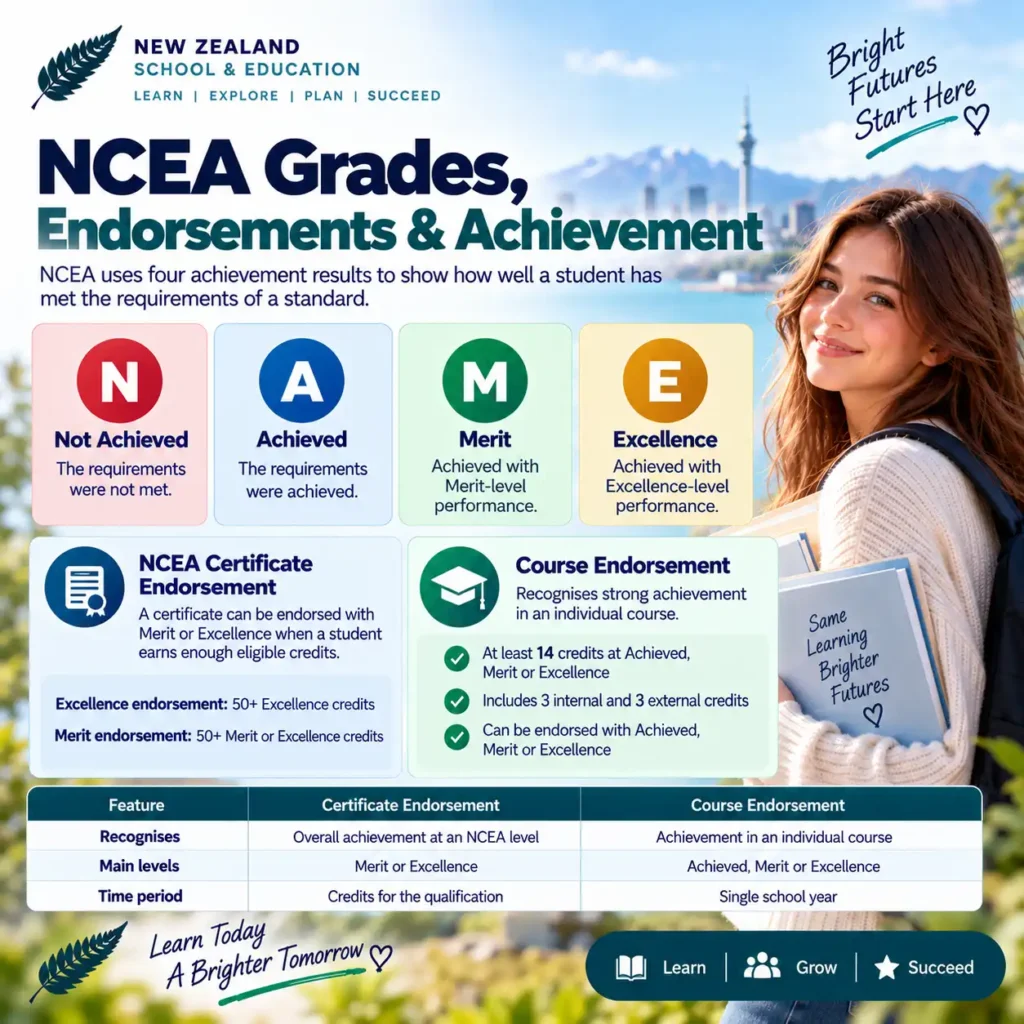
NCEA standards generally use four achievement results: Not Achieved, Achieved, Merit and Excellence. The result shows how well a student has met the requirements of the standard. Students do not receive extra credits simply because they achieve Merit or Excellence. :contentReference[oaicite:1]{index=1}
Not Achieved
The requirements of the standard were not met.
Achieved
The requirements of the standard were achieved.
Merit
The standard was achieved with Merit-level performance.
Excellence
The standard was achieved with Excellence-level performance.
NCEA Certificate Endorsement
A certificate can be endorsed with Merit or Excellence when a student earns enough eligible Merit or Excellence credits at the same or higher level as the NCEA certificate.
Under the 2026 rules, an Excellence certificate endorsement requires 50 or more eligible Excellence credits. A Merit endorsement requires 50 or more eligible Merit or Excellence credits. :contentReference[oaicite:2]{index=2}
Recognition in an Individual Course
A course endorsement recognises strong achievement in an individual course during a single school year. In most courses, students need at least 14 credits at Achieved, Merit or Excellence, including at least 3 internally assessed credits and 3 externally assessed credits. :contentReference[oaicite:3]{index=3}
A course can be endorsed with Achieved, Merit or Excellence depending on the results contributing to the endorsement. Some courses have specific exemptions from the usual internal and external assessment requirements. :contentReference[oaicite:4]{index=4}
Certificate vs Course Endorsement
| Feature | Certificate Endorsement | Course Endorsement |
|---|---|---|
| Recognises | Overall achievement at an NCEA level | Achievement in an individual course |
| Main levels | Merit or Excellence | Achieved, Merit or Excellence |
| Time period | Credits contributing to the qualification | Single school year |
Endorsements Are Different From NCEA Qualifications
An endorsement recognises a particular level of achievement. It does not replace the requirements for gaining an NCEA qualification. University Entrance is also a separate award, not an NCEA certificate. :contentReference[oaicite:5]{index=5}
NCEA and University Entrance
University Entrance (UE) is the minimum requirement for going from school to a New Zealand university. UE is a separate award from an NCEA certificate. Once a student meets the requirements, UE appears on their NZQA Record of Achievement. :contentReference[oaicite:0]{index=0}
Meeting UE does not automatically guarantee entry to every university programme. Individual degrees can have additional subject or achievement requirements, so students should check the requirements of the programme they want to study.
Current University Entrance Requirements
You need to achieve NCEA Level 3.
You need 14 credits at Level 3 in each of three approved subjects.
You need 10 approved literacy credits at Level 2 or above, including 5 reading and 5 writing credits.
You need 10 approved numeracy credits at Level 1 or above, using the current UE numeracy requirements.
NCEA and UE Are Not the Same
NCEA is a secondary school qualification, while University Entrance is an award that confirms a student has met the minimum requirements for entry to a New Zealand university. A student can therefore have NCEA results without automatically having UE. :contentReference[oaicite:1]{index=1}
UE Literacy Requirements
The UE literacy requirement is 10 credits at Level 2 or above. These must include at least 5 approved reading credits and 5 approved writing credits. NZQA maintains the list of standards that can meet the literacy requirement. :contentReference[oaicite:2]{index=2}
UE Numeracy Requirements
The current UE numeracy requirement is 10 credits at Level 1 or above. Students can meet it through the current approved numeracy pathways, including the specified Level 1 numeracy or pāngarau unit standards and certain approved achievement standards. :contentReference[oaicite:3]{index=3}
The NCEA literacy and numeracy co-requisite and the UE literacy and numeracy requirements should not be treated as identical requirements. NZQA provides separate guidance for each.
Planning Subjects for University
Students planning university study should check the subjects and standards required for their intended degree. Some university programmes have specific prerequisites, including particular mathematics or science standards.
Meeting the general UE requirements is the minimum entry requirement. Individual universities and programmes may have additional requirements.
| UE Area | Current Requirement |
|---|---|
| NCEA | NCEA Level 3 |
| Approved Subjects | 14 Level 3 credits in each of 3 approved subjects |
| Literacy | 10 credits at Level 2+, including 5 reading and 5 writing |
| Numeracy | 10 approved credits at Level 1+ |
Check Requirements Before Choosing Your Courses
NZQA’s University Entrance requirements can change. Students should check the current NZQA requirements and the entry requirements of their chosen university and degree before making subject decisions.
NCEA Results and Record of Achievement
NZQA records a student’s NCEA results and qualifications as part of their official education record. Students can access their results through NZQA’s online services and can order official documents when they need proof of their qualifications or results.
The Record of Achievement is an official NZQA document that lists a student’s national qualifications and standards achieved. It can be useful when applying for further study, employment or other opportunities where evidence of achievement is required.
Check Results
Students can check their NZQA results through their online learner account.
View Achievements
The record can show qualifications, standards, credits and other recognised achievements.
Order Documents
Official NZQA documents can be ordered when formal evidence of achievement is required.
What Is a Record of Achievement?
A Record of Achievement is an official NZQA record of a learner’s national qualifications and standards achieved. It can provide a summary of recognised achievement across a student’s secondary education and later NZQA-assessed study.
Students should use the official NZQA service when they need an official copy or verified evidence of their results.
When Might You Need Your NCEA Results?
Further Study
You may need evidence of your qualifications or results when applying for tertiary education.
Employment
An employer may ask for evidence of education or qualifications as part of an application.
Overseas Applications
Students applying overseas may need official documents showing their New Zealand qualifications.
Personal Records
Keeping an official record can make it easier to provide evidence of achievements later.
NCEA Results vs Record of Achievement
| Item | Purpose | Where to Access |
|---|---|---|
| NCEA Results | Check assessment and qualification results | NZQA online services |
| Record of Achievement | Official record of qualifications and standards achieved | NZQA |
Use NZQA for Official Results
If you need an official copy of your NCEA results or qualification record, use NZQA’s official services. Schools and third-party websites may provide information, but NZQA is the authoritative source for official NZQA records.
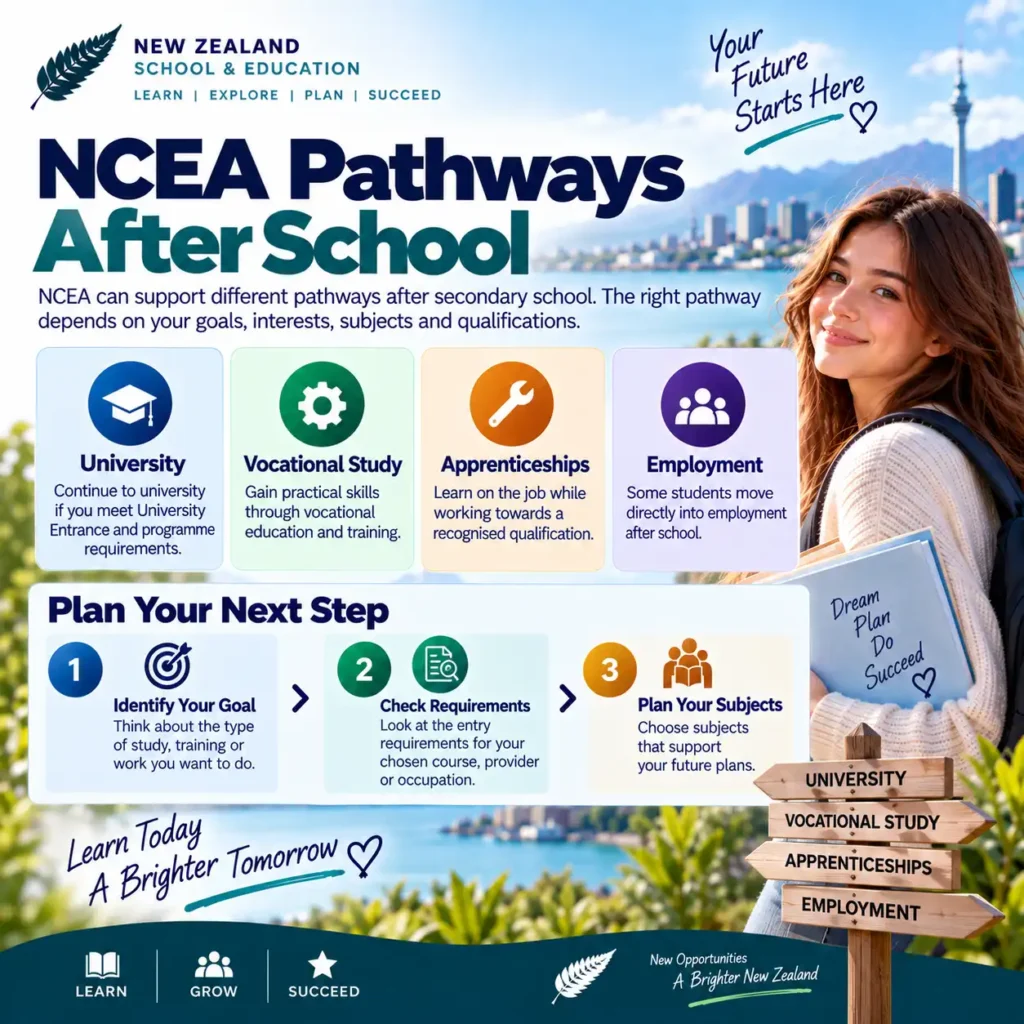
NCEA Pathways After School
NCEA can support different pathways after secondary school. Depending on their goals, students may continue to university, undertake vocational education and training, move into an apprenticeship, or enter employment.
The right pathway depends on the student’s qualifications, subjects, skills, interests and future plans. Some tertiary programmes also have specific entry requirements, so students should check the requirements of their chosen provider before applying.
University
Students who meet University Entrance can apply for university, subject to programme-specific requirements.
Vocational Study
Students can continue into vocational education and training for practical and career-focused qualifications.
Apprenticeships
Apprenticeships combine workplace learning with structured training towards an industry qualification.
Employment
Some students move directly into employment after finishing secondary school.
University Pathway
University is one possible pathway for students who want to continue academic study. In New Zealand, students generally need University Entrance as the minimum school-to-university entry requirement.
Individual university programmes can have additional requirements. These may include specific subjects, standards, grades or other selection criteria.
Vocational Education and Training
Vocational education can provide practical learning connected to particular industries and occupations. Students can explore programmes through recognised tertiary and vocational education providers.
Entry requirements vary between programmes. Students should check the provider’s current entry information before applying.
Apprenticeships and Workplace Learning
Apprenticeships provide a pathway where learners develop skills through workplace training while working towards recognised qualifications. They can be useful for students who prefer practical, industry-based learning.
Planning Your Next Step
Think about the type of study, training or work you want to pursue.
Check the current entry requirements for your chosen course, provider or occupation.
Choose school subjects and courses that support your future plans.
NCEA Is Not the Only Factor
NCEA results can be part of a student’s pathway, but further study, training and employment can have different entry requirements. Always check the current requirements of the organisation or provider you plan to apply to.
New Zealand Scholarship
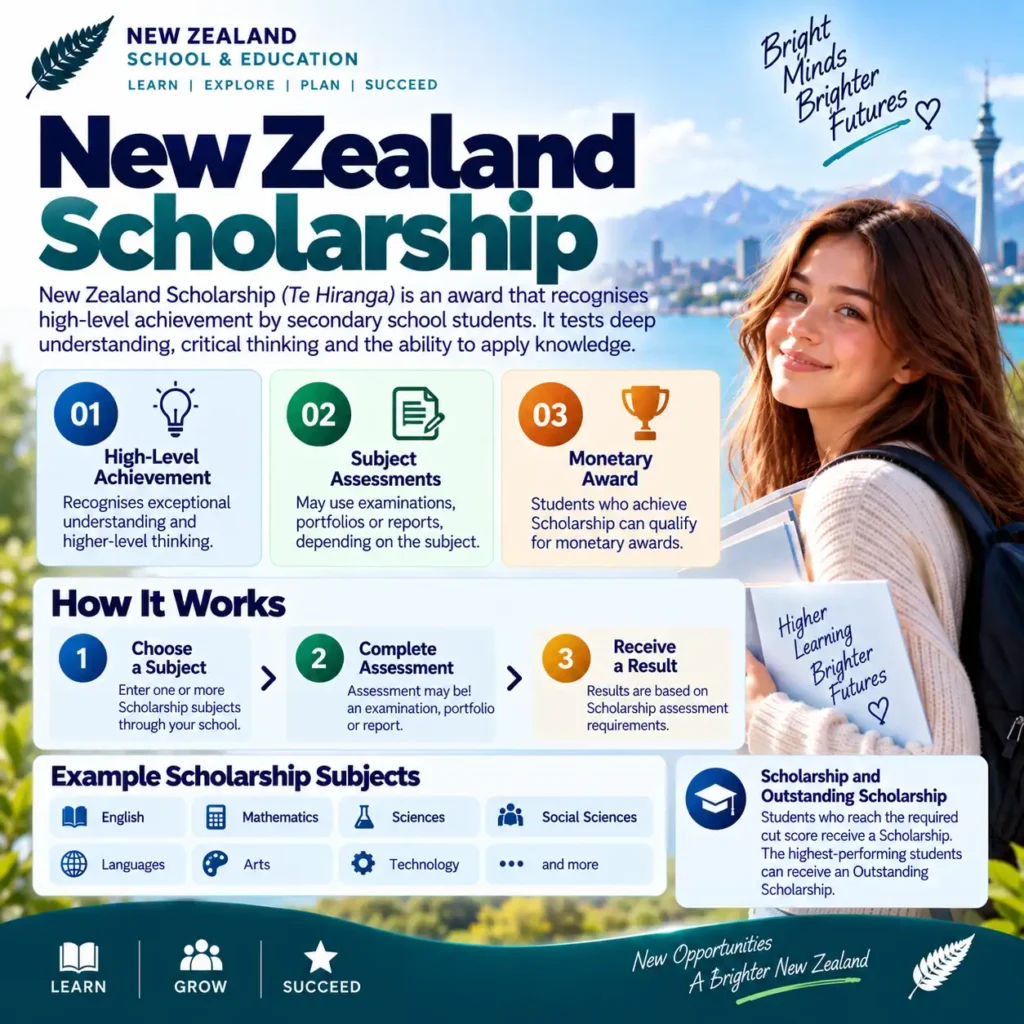
New Zealand Scholarship, also known as NZ Scholarship or Te Hiranga, is an award that recognises high-level achievement by secondary school students. Scholarship assessments are designed to test deep understanding, critical thinking and the ability to apply knowledge to complex situations. :contentReference[oaicite:0]{index=0}
Students can enter Scholarship assessments in available subjects. They do not have to be working towards NCEA to enter NZ Scholarship, although they must be enrolled in a consented New Zealand secondary school. :contentReference[oaicite:1]{index=1}
High-Level Achievement
Scholarship recognises students who demonstrate exceptional understanding and higher-level thinking in a subject.
Subject Assessments
Assessments may use examinations, portfolios or reports, depending on the Scholarship subject.
Monetary Award
Students who achieve Scholarship can qualify for monetary awards, subject to the applicable rules.
How New Zealand Scholarship Works
Students can enter one or more available Scholarship subjects through their school.
The assessment format depends on the subject and may involve an examination, portfolio or report.
Results are based on the Scholarship assessment requirements and applicable performance standards.
Scholarship Subjects
NZQA currently provides Scholarship assessment resources across a broad range of subjects. These include English, Mathematics-related subjects, Sciences, Social Sciences, Languages, Arts, Technology, Health and other learning areas. :contentReference[oaicite:2]{index=2}
Scholarship and Outstanding Scholarship
NZ Scholarship assessments use subject-specific scoring. Students who reach the required Scholarship cut score receive the Scholarship award, while the highest-performing students can receive an Outstanding Scholarship. :contentReference[oaicite:3]{index=3}
NZQA explains that assessment parts are scored from 0 to 8, with the final result based on the combined score and applicable cut scores. :contentReference[oaicite:4]{index=4}
How Students Enter
Students should talk to their teacher or school about entering Scholarship. Not all schools enter students for every Scholarship subject, and some schools may only enter students in selected subjects. :contentReference[oaicite:5]{index=5}
Scholarship Assessment Dates
Scholarship assessments follow NZQA’s national assessment timetable. Dates vary by year and subject, so students should check the current NZQA timetable rather than relying on older dates. :contentReference[oaicite:6]{index=6}
NCEA and Scholarship Are Different
New Zealand Scholarship is separate from NCEA. A student does not have to be working towards NCEA to enter Scholarship, although Scholarship is designed for high-level secondary school achievement. :contentReference[oaicite:7]{index=7}
NCEA Changes and the Future of Senior Secondary Qualifications
New Zealand is changing its senior secondary qualification system. The current NCEA system will eventually be replaced by three new qualifications: the Foundational Award, the New Zealand Certificate of Education (NZCE), and the New Zealand Advanced Certificate of Education (NZACE).
The transition is being introduced in stages. Students and parents should therefore check the qualification that applies to their year level and the current information published by the Ministry of Education and NZQA.
Foundational Award
The new Foundational Award begins for Year 11 students.
NZCE
The New Zealand Certificate of Education begins for Year 12.
NZACE
The New Zealand Advanced Certificate of Education begins for Year 13.
Phased Change
The new qualifications are being introduced progressively.
The Three New Qualifications
Foundational Award
This qualification is designed to recognise foundational knowledge, skills and capabilities at the beginning of the senior secondary pathway.
NZCE
The New Zealand Certificate of Education is planned as the next senior secondary qualification following the Foundational Award.
NZACE
The New Zealand Advanced Certificate of Education is planned as the advanced senior secondary qualification.
What Does This Mean for Students?
Students currently working through NCEA will continue to follow the qualification requirements that apply to their cohort while the new system is introduced.
Students moving through Years 11, 12 and 13 during the transition should use current Ministry of Education and NZQA guidance rather than assuming that future qualification rules already apply to them.
Why Is the Senior Qualification System Changing?
The Ministry of Education says the new senior secondary qualifications are intended to provide a clearer and more consistent qualification pathway for students.
The changes are being developed and implemented over several years. The exact requirements, assessment arrangements and transition information should therefore be checked against the latest official guidance.
Senior Qualification Transition Timeline
| Year | New Qualification | Student Year Level |
|---|---|---|
| 2028 | Foundational Award | Year 11 |
| 2029 | New Zealand Certificate of Education | Year 12 |
| 2030 | New Zealand Advanced Certificate of Education | Year 13 |
Check the Latest Official Information
The senior secondary qualification transition is a multi-year process. For current requirements, assessment arrangements and implementation updates, check the latest information from the Ministry of Education and NZQA.
NCEA Frequently Asked Questions
Here are common questions about NCEA levels, credits, assessments, endorsements, University Entrance and current NCEA changes.
What does NCEA stand for?
NCEA stands for National Certificate of Educational Achievement. It is New Zealand’s main secondary school qualification.
How many NCEA levels are there?
There are three NCEA qualification levels: Level 1, Level 2 and Level 3. Students commonly work through them during Years 11 to 13, although the timing can vary.
How many credits do I need for NCEA?
Under the current NCEA structure, each level requires 60 applicable credits at the required level or above. A separate 20-credit literacy, numeracy, te reo matatini or pāngarau co-requisite also applies to the qualification.
Are NCEA credits the same as marks or percentages?
No. NCEA credits are awarded when a student achieves an assessment standard. A standard can contribute credits toward a qualification, while the result can be Not Achieved, Achieved, Merit or Excellence.
What is the NCEA co-requisite?
The co-requisite covers literacy or te reo matatini and numeracy or te pāngarau. The current NCEA qualification structure requires 20 credits for this co-requisite, separate from the 60-credit qualification requirement.
What are the four NCEA grades?
NCEA standards can be reported as Not Achieved, Achieved, Merit or Excellence. The result depends on the assessment standard and the evidence demonstrated by the student.
What is an NCEA certificate endorsement?
A certificate endorsement recognises strong performance across an NCEA qualification. A student can earn a Merit or Excellence certificate endorsement when the required number of eligible credits is achieved at the relevant grade.
What is a course endorsement?
A course endorsement recognises strong achievement in an individual course. The requirements include achieving at least 14 credits at Achieved, Merit or Excellence, subject to the current endorsement rules and applicable internal and external credit requirements.
Is University Entrance the same as NCEA Level 3?
No. University Entrance is a separate minimum requirement for entry from school to a New Zealand university. The current UE requirements include NCEA Level 3, 14 Level 3 credits in each of three approved subjects, literacy requirements and numeracy requirements.
Can I earn NCEA credits in more than one year?
Yes. NCEA credits can be accumulated over time. The standards and qualification requirements that apply depend on the student’s qualification level, programme and current NZQA rules.
Is NCEA changing?
Yes. NCEA is being updated in stages. The new Level 1 qualification was introduced in 2024. Level 2 is being implemented in 2026 and Level 3 in 2027. The wider senior secondary qualification system is also planned to transition to new qualifications from 2028 onward.
Where can I check my official NCEA results?
Students should use NZQA’s official services for their results and Record of Achievement. NZQA maintains the official record of national qualifications and assessment standards achieved.
NCEA Information Can Change
NCEA requirements and assessment arrangements are being updated during the current transition. Always check the latest NZQA and Ministry of Education information for the rules that apply to your year and qualification.
Official NCEA Sources
NCEA requirements, assessment rules and qualification changes can change over time. We use official New Zealand sources to help keep this guide accurate and useful.
New Zealand Qualifications Authority
NZQA provides official information about NCEA qualifications, assessment, results, endorsements, University Entrance and New Zealand Scholarship.
Visit NZQANCEA Education
The official NCEA Education website provides information about NCEA changes, achievement standards, subjects, assessment and the future senior secondary qualification system.
Visit NCEA EducationNew Zealand Ministry of Education
The Ministry provides official information about New Zealand’s education system, curriculum and the wider changes affecting senior secondary education.
Visit Ministry of EducationOfficial NCEA Results
Students can use the official NZQA learner portal to view qualifications, course and certificate endorsements, University Entrance, Scholarship results and assessment results.
Check NCEA ResultsImportant Source Note
NZ Education Hub is an independent information website. We are not affiliated with NZQA or the New Zealand Ministry of Education. For official requirements, results, assessment dates and current qualification rules, always refer to the relevant government or NZQA source.
Sources checked for this guide: NZQA and New Zealand Ministry of Education information available in September 2026.