Understanding NCEA Literacy and Numeracy
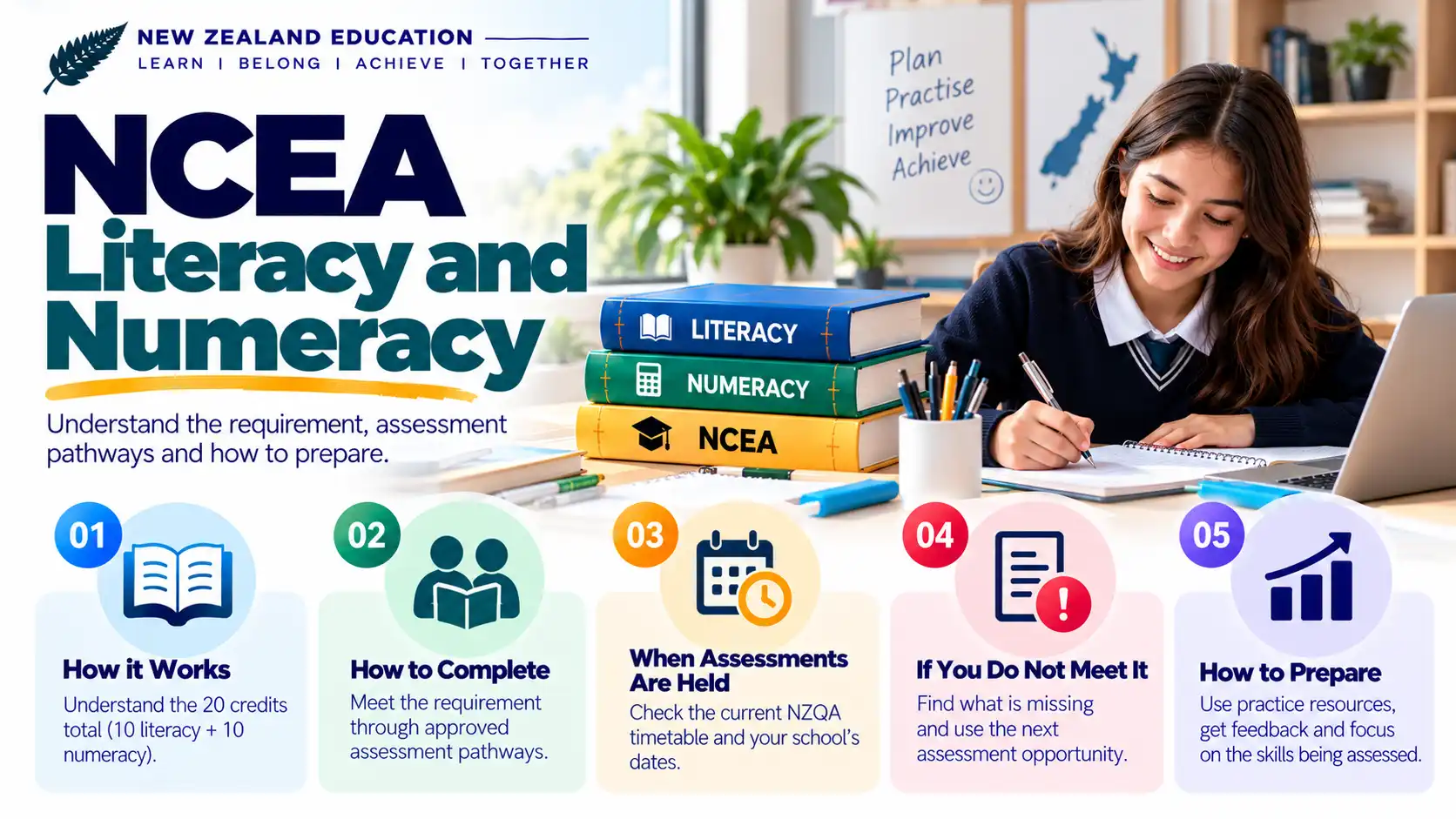
NCEA literacy and numeracy are important parts of completing an NCEA qualification. This guide explains the requirement, how the credits work, and what students need to know before completing their assessments.
The co-requisite is met once and applies across NCEA Levels 1, 2 and 3.
What Are NCEA Literacy and Numeracy Requirements?
The NCEA literacy and numeracy co-requisite checks that students have demonstrated important reading, writing and mathematical skills. It is a separate requirement within NCEA and should be considered when planning your assessment pathway.
Students need 10 literacy or Te Reo Matatini credits and 10 numeracy or Pāngarau credits, giving a total of 20 credits. Once the co-requisite has been met, it applies to NCEA Levels 1, 2 and 3.
Literacy
Focuses on the reading and writing skills needed to understand and communicate information.
Numeracy
Focuses on using mathematical ideas and skills to work with numbers and solve problems.
One Co-Requisite
The literacy and numeracy requirement is met once and can count across all three NCEA levels.
Table of Contents
How the NCEA Literacy and Numeracy Requirement Works
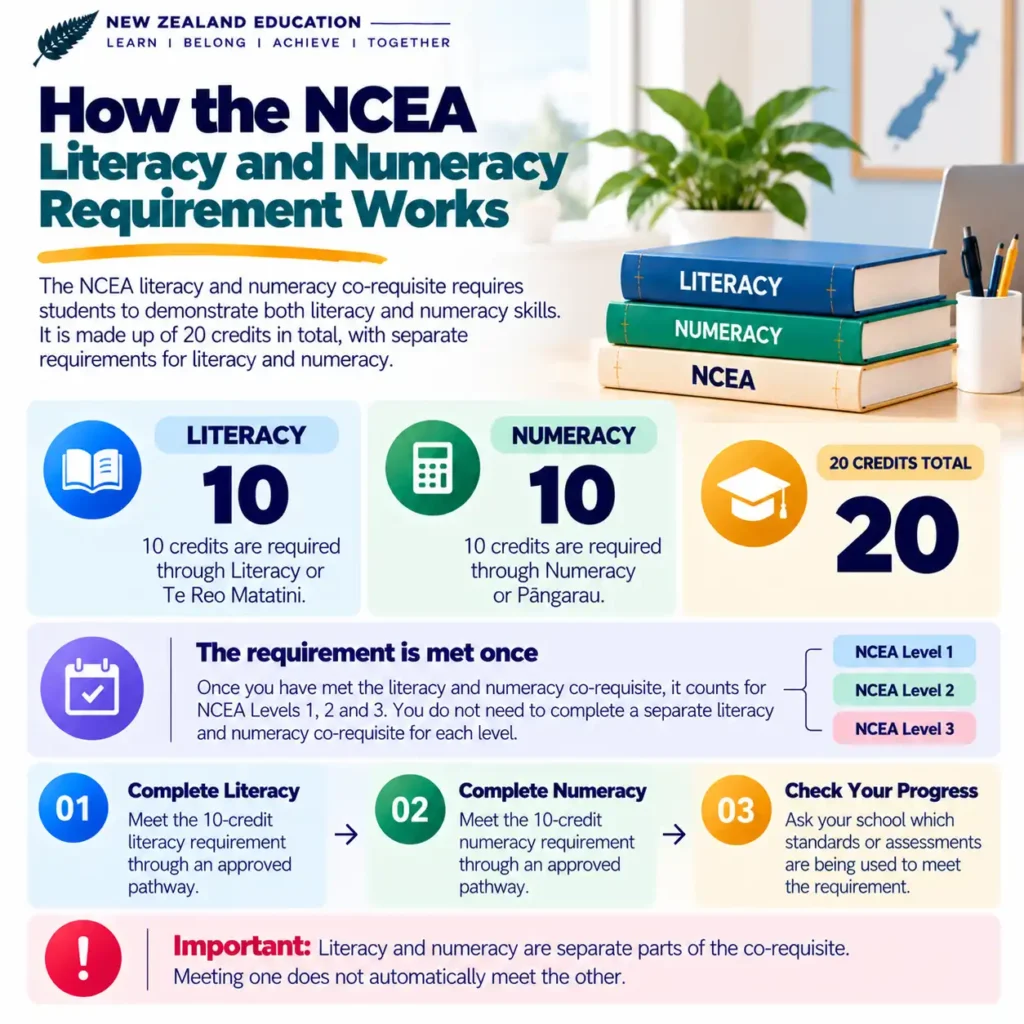
The NCEA literacy and numeracy co-requisite requires students to demonstrate both literacy and numeracy skills. It is made up of 20 credits in total, with separate requirements for literacy and numeracy.
10 credits are required through Literacy or Te Reo Matatini.
10 credits are required through Numeracy or Pāngarau.
The requirement is met once
Once you have met the literacy and numeracy co-requisite, it counts for NCEA Levels 1, 2 and 3. You do not need to complete a separate literacy and numeracy co-requisite for each level.
Complete Literacy
Meet the 10-credit literacy requirement through an approved pathway.
Complete Numeracy
Meet the 10-credit numeracy requirement through an approved pathway.
Check Your Progress
Ask your school which standards or assessments are being used to meet the requirement.
What Counts as NCEA Literacy?
The literacy part of the NCEA co-requisite is designed to show that a student can understand and communicate information through reading and writing. Students need to meet the required literacy credits through an approved literacy pathway.
Reading
Students demonstrate that they can read and understand information, ideas and texts and use what they have read appropriately.
Writing
Students demonstrate that they can communicate ideas and information clearly through written language for an appropriate purpose.
10 literacy credits are required
The literacy requirement can be met through the approved Literacy or Te Reo Matatini pathway. Your school can explain which standards or assessments you are completing and how they contribute to the co-requisite.
Understand Texts
Reading skills help students work with information, ideas and different types of texts.
Communicate Clearly
Writing skills help students communicate ideas and information for a clear purpose.
Check Your Pathway
Check with your school which approved literacy standards or assessments you are using.
What Counts as NCEA Numeracy?
The numeracy part of the NCEA co-requisite shows that a student can use mathematical ideas and skills to understand information and solve everyday problems. Students need to meet the required numeracy credits through an approved numeracy pathway.
Numeracy
Students use mathematical knowledge and strategies to work with numbers, information and problems in practical situations.
Pāngarau
Students following the Māori-medium pathway can use the Pāngarau pathway to meet the numeracy part of the co-requisite.
10 numeracy credits are required
The numeracy requirement can be met through the approved Numeracy or Pāngarau pathway. Your school or provider can tell you which standards or assessments you are using to meet the requirement.
Work With Numbers
Use numbers and mathematical information to understand situations and make decisions.
Solve Problems
Apply mathematical strategies to practical problems and situations.
Check Your Pathway
Confirm with your school which approved numeracy standards or assessments you are completing.
How Students Complete the Literacy and Numeracy Co-Requisite
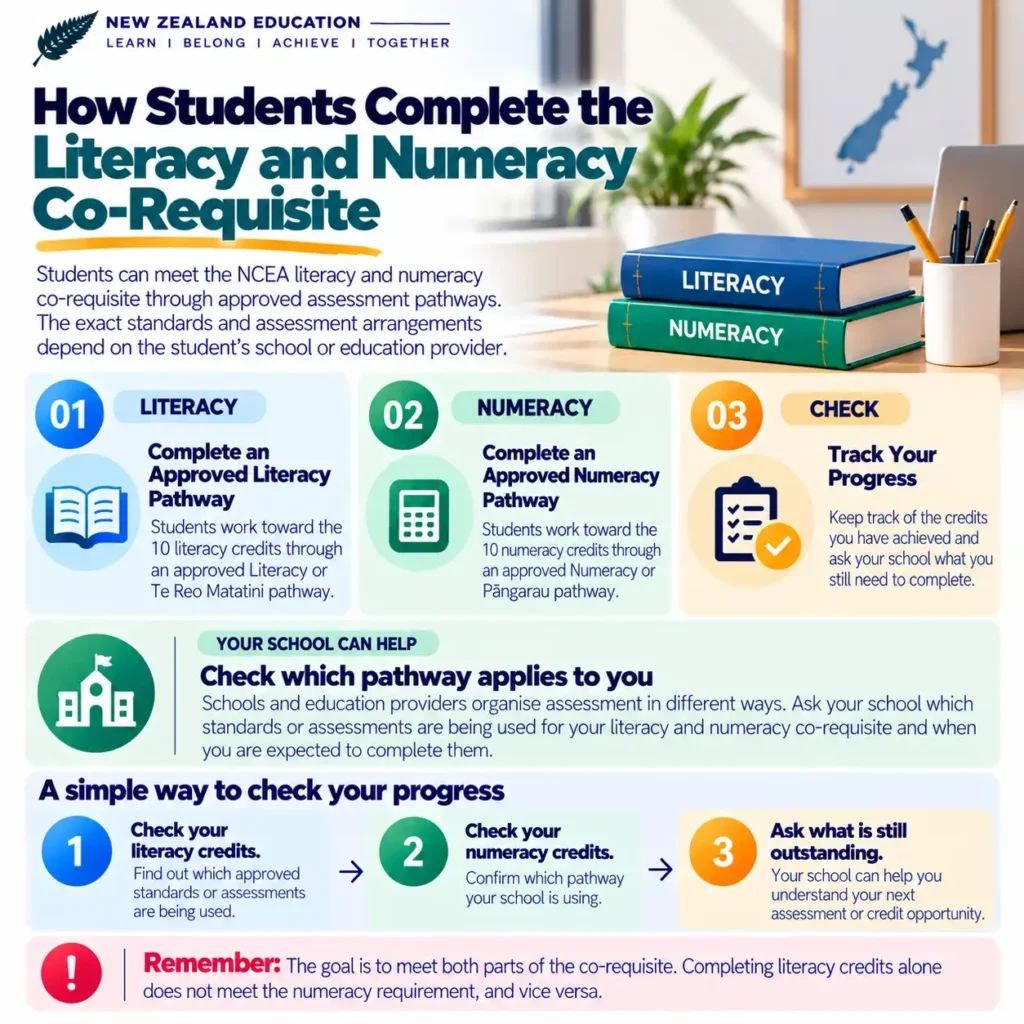
Students can meet the NCEA literacy and numeracy co-requisite through approved assessment pathways. The exact standards and assessment arrangements depend on the student’s school or education provider.
Complete an Approved Literacy Pathway
Students work toward the 10 literacy credits through an approved Literacy or Te Reo Matatini pathway.
Complete an Approved Numeracy Pathway
Students work toward the 10 numeracy credits through an approved Numeracy or Pāngarau pathway.
Track Your Progress
Keep track of the credits you have achieved and ask your school what you still need to complete.
Check which pathway applies to you
Schools and education providers organise assessment in different ways. Ask your school which standards or assessments are being used for your literacy and numeracy co-requisite and when you are expected to complete them.
A simple way to check your progress
NCEA Literacy and Numeracy Assessments
NCEA literacy and numeracy assessments are designed to show that students can use important reading, writing and mathematical skills. The assessment pathway used will depend on the standards and arrangements selected by the school or education provider.
Reading
Students demonstrate their ability to understand and work with information and ideas in texts.
Writing
Students demonstrate their ability to communicate ideas and information through writing.
Numeracy
Students use mathematical knowledge and strategies to work with information and solve problems.
Dedicated Literacy and Numeracy Standards
NZQA’s current assessment information includes dedicated standards for literacy reading, literacy writing and numeracy. Students should use the current NZQA information and their school’s assessment plan to confirm which assessments apply to them.
What Should Students Check?
Check your assessment pathway. Find out which standards or assessments your school is using.
Know what each assessment measures. Reading, writing and numeracy assess different skills.
Use current NZQA resources. Assessment dates, standards and requirements can change, so check the latest official information.
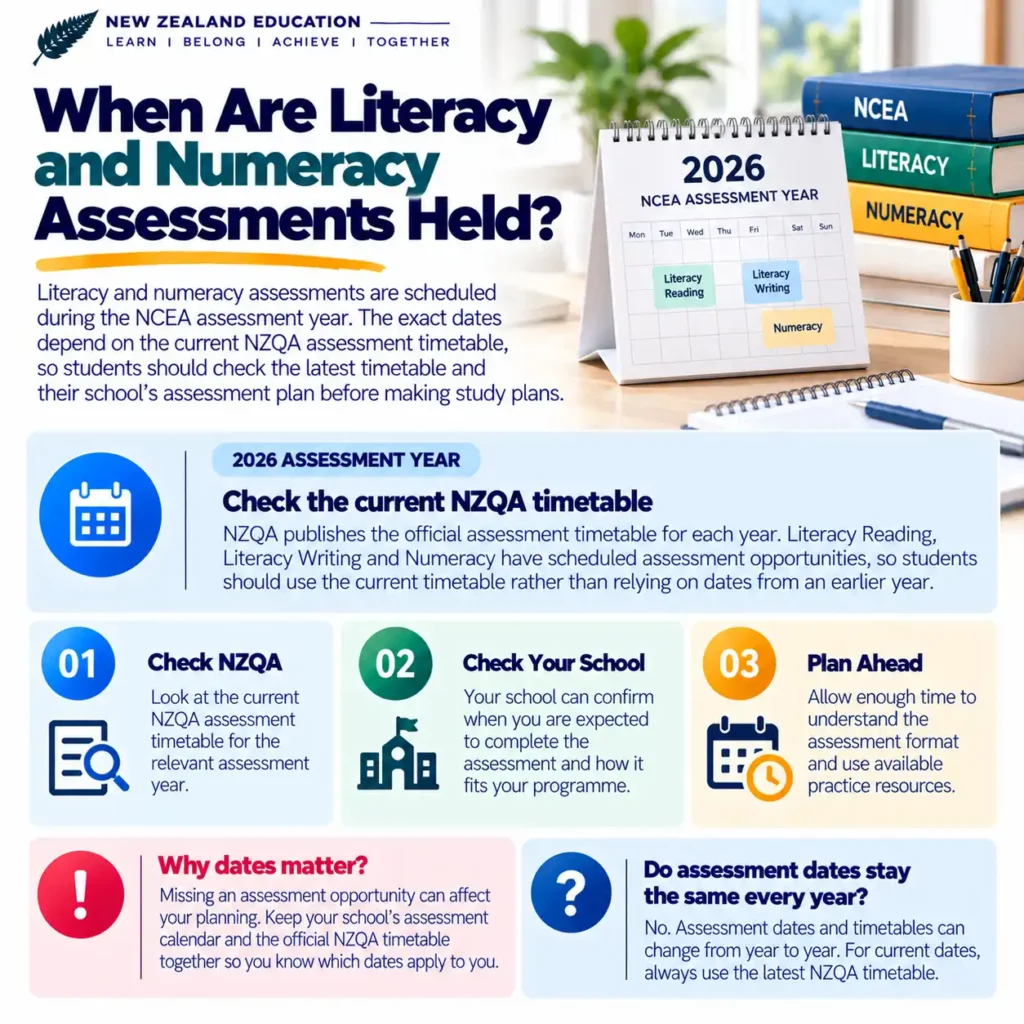
When Are Literacy and Numeracy Assessments Held?
Literacy and numeracy assessments are scheduled during the NCEA assessment year. The exact dates depend on the current NZQA assessment timetable, so students should check the latest timetable and their school’s assessment plan before making study plans.
Check the current NZQA timetable
NZQA publishes the official assessment timetable for each year. Literacy Reading, Literacy Writing and Numeracy have scheduled assessment opportunities, so students should use the current timetable rather than relying on dates from an earlier year.
Check NZQA
Look at the current NZQA assessment timetable for the relevant assessment year.
Check Your School
Your school can confirm when you are expected to complete the assessment and how it fits your programme.
Plan Ahead
Allow enough time to understand the assessment format and use available practice resources.
Do assessment dates stay the same every year?
No. Assessment dates and timetables can change from year to year. This page focuses on how students should plan rather than treating one year’s dates as permanent. For current dates, always use the latest NZQA timetable.
Can Other Subjects Count Toward the Requirement?
Yes. The literacy and numeracy co-requisite is not limited to one particular school subject. Approved standards from different learning areas may contribute when they meet the relevant NCEA literacy or numeracy requirements.
Literacy-rich standards
Some approved standards in different subjects can contribute to the literacy requirement when they are listed by NZQA as meeting the relevant requirement.
Numeracy-rich standards
Some approved standards can contribute to the numeracy requirement when they meet NZQA’s current numeracy criteria.
A subject is not automatically a literacy or numeracy pathway
Taking a subject such as English, mathematics or another subject does not by itself guarantee that its credits will meet the co-requisite. What matters is whether the specific standard is approved for the literacy or numeracy requirement.
How to check whether credits count
Identify the standard. Ask your school which standard you are completing.
Check the current NZQA information. Confirm whether that standard can contribute to literacy or numeracy.
Check your progress. Make sure you are meeting both the literacy and numeracy parts of the co-requisite.
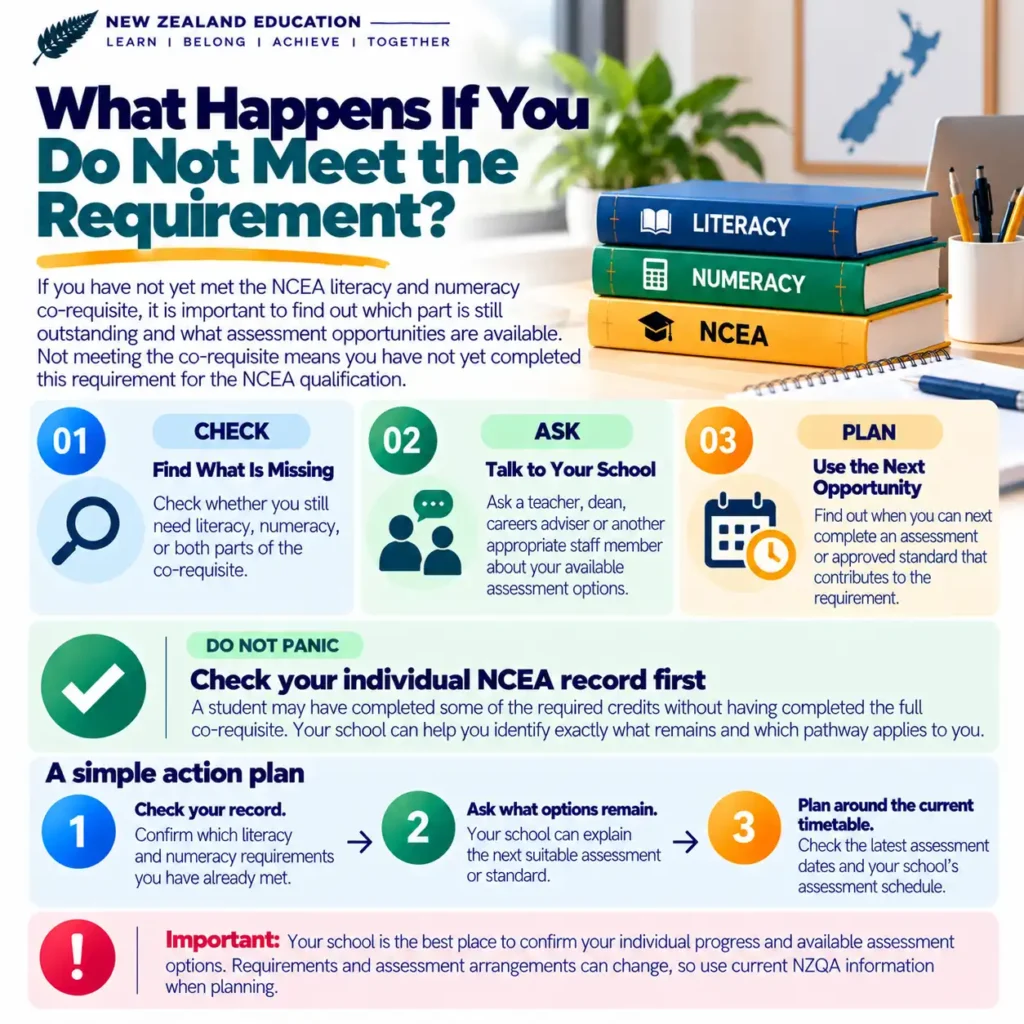
What Happens If You Do Not Meet the Requirement?
If you have not yet met the NCEA literacy and numeracy co-requisite, it is important to find out which part is still outstanding and what assessment opportunities are available. Not meeting the co-requisite means you have not yet completed this requirement for the NCEA qualification.
Find What Is Missing
Check whether you still need literacy, numeracy, or both parts of the co-requisite.
Talk to Your School
Ask a teacher, dean, careers adviser or another appropriate staff member about your available assessment options.
Use the Next Opportunity
Find out when you can next complete an assessment or approved standard that contributes to the requirement.
Check your individual NCEA record first
A student may have completed some of the required credits without having completed the full co-requisite. Your school can help you identify exactly what remains and which pathway applies to you.
A simple action plan
Check your record. Confirm which literacy and numeracy requirements you have already met.
Ask what options remain. Your school can explain the next suitable assessment or standard.
Plan around the current timetable. Check the latest assessment dates and your school’s assessment schedule.
Literacy and Numeracy Across NCEA Levels 1, 2 and 3
The literacy and numeracy co-requisite is connected to the NCEA qualification rather than being a separate requirement that students must repeat at every level. Once the co-requisite has been met, it counts towards NCEA Levels 1, 2 and 3.
Start Building Your Record
Students can work toward the literacy and numeracy co-requisite as part of their NCEA planning and assessment programme.
Check What You Have Completed
If you have already met the co-requisite, you do not need to complete it again for Level 2.
Keep Track of Your Progress
Students who have not yet met the co-requisite should check their remaining requirements and available assessment opportunities.
You do not start the requirement again at each level
The important point is to know whether you have already met the literacy and numeracy co-requisite. If it has been met, it remains recognised for the NCEA qualification at Levels 1, 2 and 3.
What should students do at each level?
Know your status. Check whether you have already met both parts of the co-requisite.
Check your school plan. Confirm which literacy and numeracy assessments or standards apply to you.
Plan ahead if anything is outstanding. Ask your school about the next available opportunity.
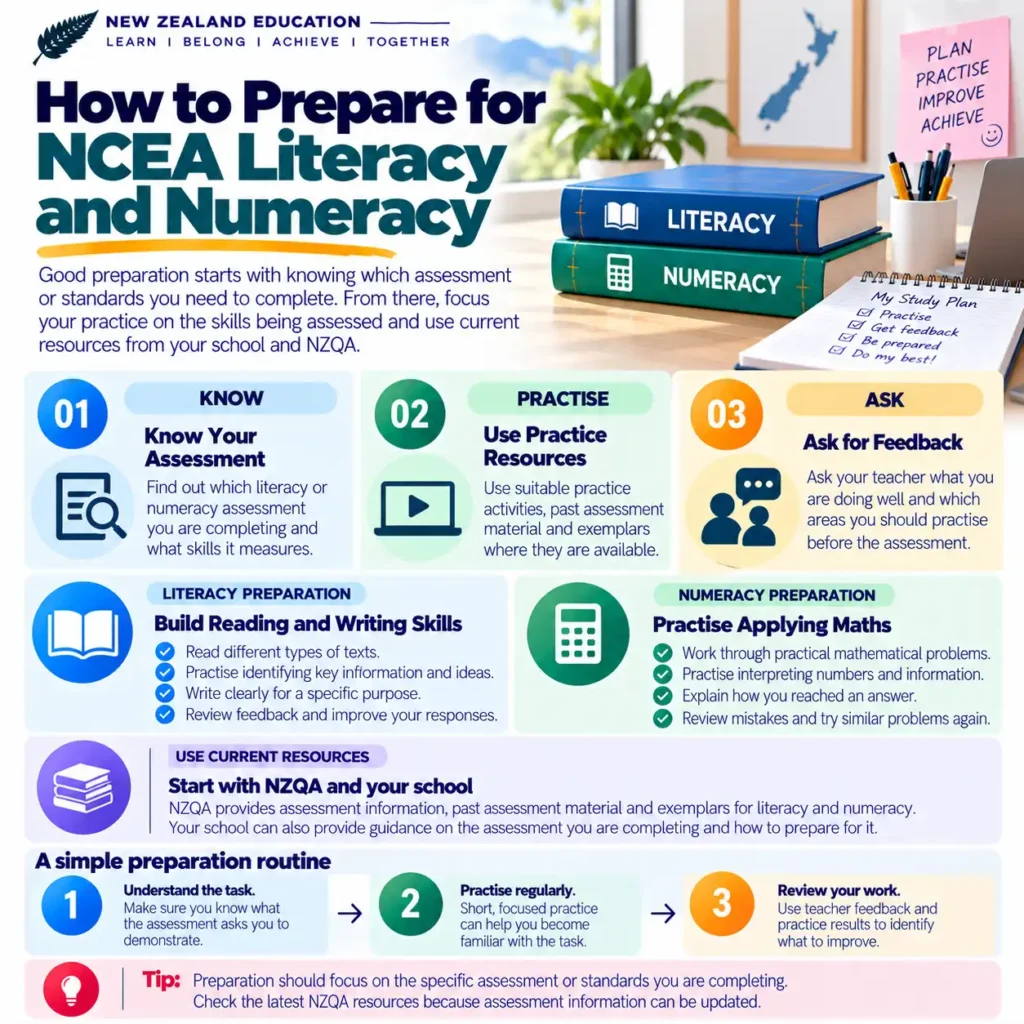
How to Prepare for NCEA Literacy and Numeracy
Good preparation starts with knowing which assessment or standards you need to complete. From there, focus your practice on the skills being assessed and use current resources from your school and NZQA.
Know Your Assessment
Find out which literacy or numeracy assessment you are completing and what skills it measures.
Use Practice Resources
Use suitable practice activities, past assessment material and exemplars where they are available.
Ask for Feedback
Ask your teacher what you are doing well and which areas you should practise before the assessment.
Build Reading and Writing Skills
- Read different types of texts.
- Practise identifying key information and ideas.
- Write clearly for a specific purpose.
- Review feedback and improve your responses.
Practise Applying Maths
- Work through practical mathematical problems.
- Practise interpreting numbers and information.
- Explain how you reached an answer.
- Review mistakes and try similar problems again.
Start with NZQA and your school
NZQA provides assessment information, past assessment material and exemplars for literacy and numeracy. Your school can also provide guidance on the assessment you are completing and how to prepare for it.
A simple preparation routine
FAQs About NCEA Literacy and Numeracy
Here are common questions students, parents and whānau may have about the NCEA literacy and numeracy co-requisite.
What is the NCEA literacy and numeracy requirement?
It is a 20-credit co-requisite made up of 10 literacy or Te Reo Matatini credits and 10 numeracy or Pāngarau credits. Once met, it counts across NCEA Levels 1, 2 and 3.
How many literacy credits do I need?
You need 10 credits through the approved literacy or Te Reo Matatini pathway.
How many numeracy credits do I need?
You need 10 credits through the approved numeracy or Pāngarau pathway.
Do I need to complete the requirement for every NCEA level?
No. Once you have met the literacy and numeracy co-requisite, it is recognised for NCEA Levels 1, 2 and 3.
Can other subjects count toward literacy?
Some approved standards from different learning areas can contribute to the literacy requirement. Check the specific standard and current NZQA information rather than relying only on the subject name.
Can other subjects count toward numeracy?
Some approved standards can contribute to the numeracy requirement. Your school can confirm which standards are being used and whether they meet the current NZQA requirements.
What is a Common Assessment Activity?
A Common Assessment Activity is an assessment developed for the NCEA literacy and numeracy co-requisite. Ask your school which assessment pathway applies to your programme.
Can I complete the literacy and numeracy requirement later?
If you have not yet met the co-requisite, speak with your school about available assessment opportunities and the pathway that applies to you.
What happens if I do not meet the co-requisite?
You have not yet completed this NCEA requirement. Check your record and speak with your school about what remains and which assessment opportunities are available.
Where can I find practice resources?
NZQA provides assessment information, past assessment material and exemplars. Your school can also provide resources and guidance for the specific assessment you are completing.
Understanding Your NCEA Literacy and Numeracy Requirements
The literacy and numeracy co-requisite is an important part of NCEA. Knowing what you need, how you can complete it and where you stand can make planning much easier.
Know the Requirement
You need to meet both the literacy and numeracy parts of the co-requisite. Check the current requirements that apply to your NCEA pathway.
Check Your Pathway
Your school can help you identify which approved standards or assessment pathway you are using and what you have already completed.
Plan Ahead
If one part is still outstanding, check upcoming opportunities and current NZQA information so you can plan your next steps.
Requirements and assessment arrangements can change. Use current NZQA information and your school’s advice when checking your individual literacy and numeracy status.