
NZ School Attendance Codes: Complete 15-Code Guide
Learn what the current New Zealand school attendance codes mean, how schools use them, and the difference between present, justified and unjustified attendance records.
Current Attendance Codes
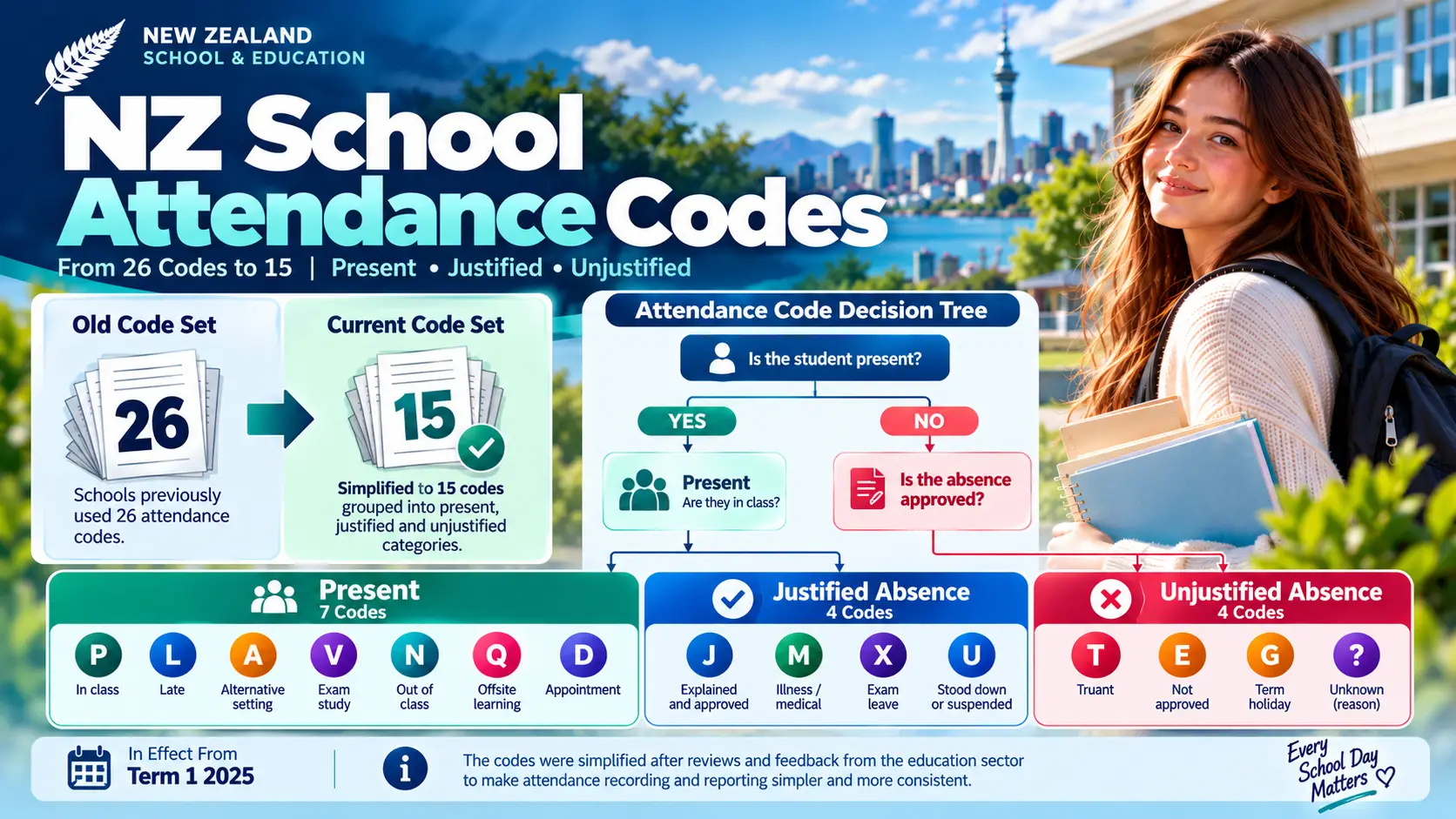
New Zealand’s attendance code set was reduced from 26 codes to 15. The revised codes began from Term 1, 2025.
What Are NZ School Attendance Codes?
NZ school attendance codes are short codes used by schools to record a student’s attendance or absence. They help schools record why a student is present, absent, late, or away from school for an approved reason.
Current Code Set
The current Ministry attendance system uses 15 attendance codes.
Main Categories
The codes are organised around present, justified absence and unjustified absence categories.
Ministry Guidance
Schools use Ministry-approved attendance codes when recording student attendance.
Attendance codes are used for official school attendance recording. The meaning of a code depends on the Ministry guidance and the circumstances of the student’s attendance or absence.
On This Page
The 15 Current NZ School Attendance Codes
New Zealand schools use 15 current attendance codes to record different attendance and absence situations. The codes are divided into present, justified absence and unjustified absence categories.
Present
P, L, A, V, N, Q and D
Justified Absence
J, M, X and U
Unjustified Absence
T, E, G and ?
| Code | Attendance Code | What It Means | Category |
|---|---|---|---|
| P | Present | The student is present in class. This also includes supervised dual tuition with Te Kura. | Present |
| L | Late to class | The student arrives late to class. The school sets its own threshold for lateness through school policy. | Present |
| A | Alternative provision | The student is present in a Ministry-approved alternative provision, such as a student education centre, tertiary programme, health school or activity centre. | Present |
| V | Unsupervised exam study | The student is on-site for an examination or unsupervised exam study. This code applies to secondary schools. | Present |
| N | Present but out of class | The student is present but temporarily out of class for an on-site school activity, internal examination, temporary removal or time in the sickbay. | Present |
| Q | Board approved offsite learning | The student is participating in Board-approved learning away from school, such as a course, work experience or other approved learning. | Present |
| D | Approved external appointment | The student has an approved external appointment that cannot be scheduled outside school hours, such as a medical appointment, including necessary travel time. | Present |
| J | Explained and approved | The absence has been explained and approved. Examples can include a family emergency, bereavement, approved exemption or certain representative regional or cultural events. | Justified |
| M | Illness / Medical absence | The student is absent because of illness or another medical reason. Ministry guidance also includes mental health-related illness in this category. | Justified |
| X | Exam leave | A secondary student is away from school studying offsite in preparation for exams. X is not included in Ministry attendance calculations. | Justified |
| U | Stood down or suspended | The student is absent because of a formal stand-down or suspension. The code applies to the relevant period, excluding the day the stand-down or suspension was imposed. | Justified |
| T | Truant | The student is absent without an explanation or permission from a parent or caregiver. | Unjustified |
| E | Explained but not approved | A reason has been provided, but it does not meet the school’s policy for a justified absence. | Unjustified |
| G | Holiday during term time | The student is absent because a holiday has been taken during the school term. | Unjustified |
| ? | Unknown reason | A temporary code used when the reason for the student’s absence is not yet known. It should be updated when the reason is confirmed. | Unjustified |
Some codes apply only to secondary schools, including V and X. Always check the current Ministry guidance and your school’s attendance policy when interpreting a specific attendance record.
Why are there 15 codes? The Ministry reduced the attendance code set from 26 to 15 at the start of 2025. Existing codes were combined into the current present, justified and unjustified categories.
NZ Present Attendance Codes
The current NZ attendance system has seven codes in the present category. These codes cover students who are in class, late, learning through approved programmes, or present outside their usual classroom setting.
Present
Present codeUse P when a student is present in class. The Ministry guidance also includes supervised dual tuition with Te Kura within this code.
Late to Class
Present codeUse L when a student is present but arrives late to class. The school determines its threshold for lateness and the process for students who arrive late through its school policy.
Alternative Provision
Present codeUse A when a student is present in a Ministry-approved alternative provision. Examples include alternative education, secondary-tertiary programmes, activity centres, teen parent units and regional health schools.
Unsupervised Exam Study
Secondary schools onlyV is used when a secondary school student is present at school for an examination or unsupervised exam study. The student remains on-site.
Present but Out of Class
Present codeN is used when a student is present but temporarily out of their classroom. This can include an on-site school activity, an internal examination, temporary removal from class or time in the sickbay.
Board Approved Offsite Learning
Present codeQ is used when a student is participating in Board-approved learning away from the school. This can include approved courses, work experience or other learning.
Approved External Appointment
Present codeD is used when a student has an approved external appointment that cannot be scheduled outside school hours. Ministry guidance includes medical appointments such as doctor or dentist visits, including travel time, as well as participation in court proceedings.
Quick Reference: Present Codes
These seven codes are all listed by the Ministry under Present for ½ day calculations. V applies only to secondary schools. The exact use of a code should follow the current Ministry guidance and the school’s policies.

NZ Justified Absence Codes
Four current NZ attendance codes are used for justified absences. They cover approved absences, illness or medical reasons, exam leave, and formal stand-downs or suspensions.
Explained and Approved
Justified absenceJ is used when the reason for a student’s absence has been explained and the absence is approved under the school’s attendance policy.
- Family emergency
- Bereavement
- Approved exemption
- Certain approved representative events
Illness / Medical Absence
Justified absenceM is used when a student cannot attend school because of illness or a medical reason. Ministry guidance includes mental health-related illness within this code.
- Short-term illness
- Injury or medical event
- Medical treatment or healthcare
- Mental health-related illness
Exam Leave
Secondary schools onlyX is used when a secondary student is away from school for unsupervised study off-site or is completing an off-site examination.
A secondary student is away from school completing unsupervised study or an external examination.
Stood Down or Suspended
Justified absenceU is used when a student is absent because they have been formally stood down or suspended.
- Applies to the relevant stand-down or suspension period.
- Does not include the day the stand-down or suspension was imposed.
- If the student attends school during a stand-down or suspension, U does not apply.
Quick Comparison
A justified absence does not mean that every absence is automatically approved. The school applies the relevant attendance rules and its policies when deciding how an absence should be recorded.
NZ Unjustified Absence Codes
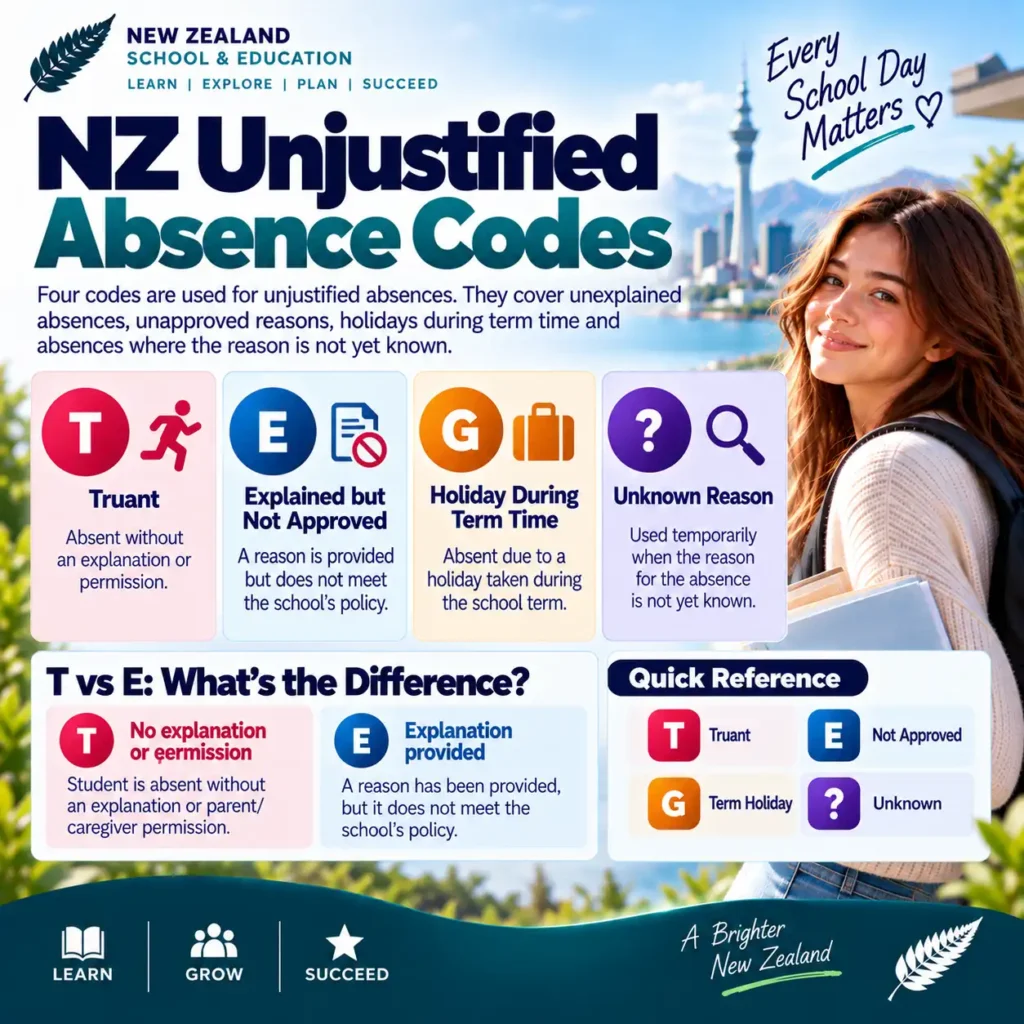
Four current NZ attendance codes are used for unjustified absences. They help schools record unexplained absences, reasons that do not meet school policy, holidays taken during term time and absences where the reason is not yet known.
Truant
Unjustified absenceT is used when a student is absent without an explanation or permission from a parent or caregiver. It can also apply when a student chooses to miss a class or leaves class without permission.
- Student skips a class
- Student leaves class without permission
- No explanation or parent/caregiver permission is provided
Explained but Not Approved
Unjustified absenceE is used when a reason has been provided for the absence, but the reason does not meet the school’s policy for a justified absence.
A parent explains that their child did not want to attend a school activity, but the reason does not meet the school’s policy for an approved absence.
Holiday During Term Time
Unjustified absenceG is used when a student is absent because a holiday is taken during the school term.
- Domestic holiday during term time
- Overseas holiday during term time
- Family travel taken during the school term
Unknown Reason
Temporary codeThe question mark code is used temporarily when a student is absent and the reason for the absence is not yet known.
- The school initially records the unknown reason.
- The school follows up to establish the reason.
- The code is updated once the reason is confirmed.
T vs E: What Is the Difference?
Both T and E are unjustified absence codes, but the key difference is whether an explanation has been provided.
No explanation or permission
The student is absent without an explanation or parent/caregiver permission.
Explanation provided
A reason has been provided, but it does not meet the school’s policy for a justified absence.
Quick Reference
The four codes in this section are all classified as unjustified absences. The Ministry guidance provides specific definitions for each code, so schools should use the code that matches the actual circumstances.
NZ School Attendance Code Decision Tree
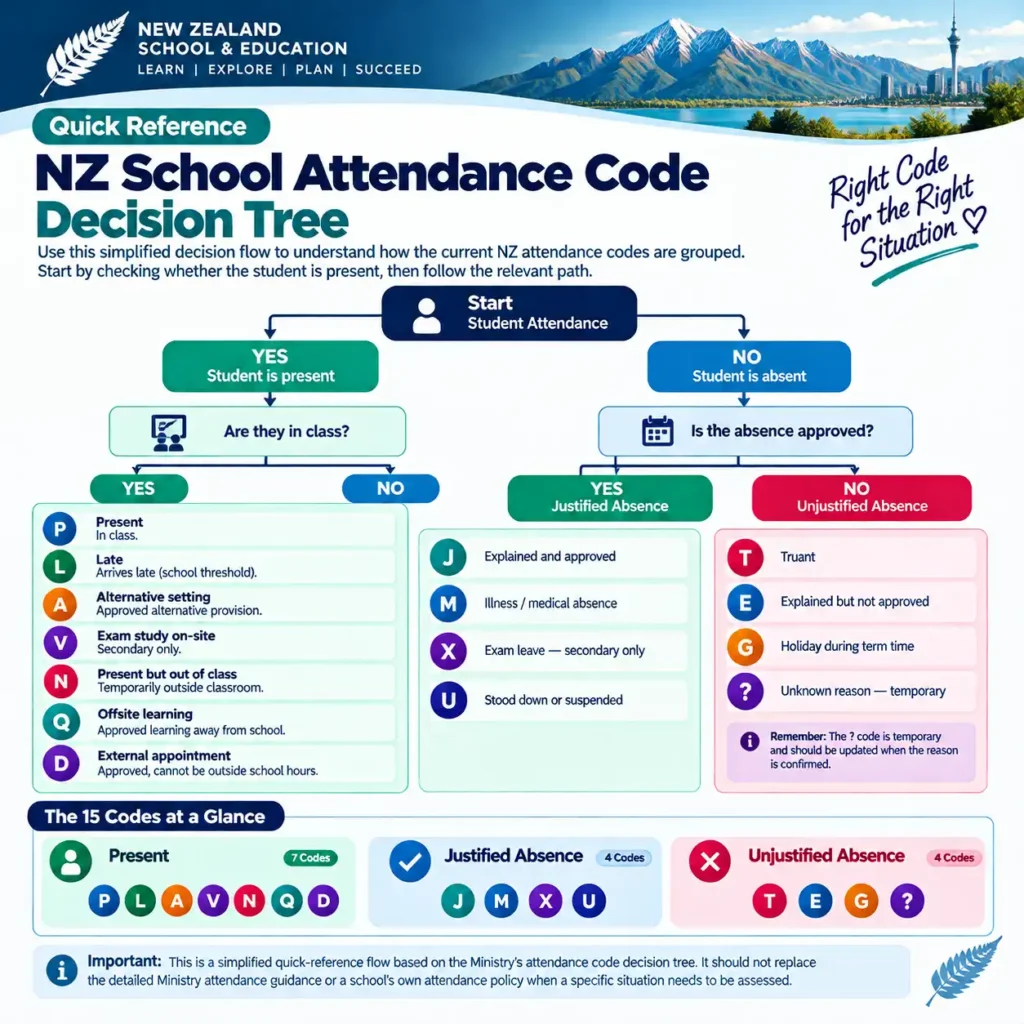
Use this simplified decision flow to understand how the current NZ attendance codes are grouped. Start by checking whether the student is present, then follow the relevant path.
Is the student present?
Student is present
Continue to the next question: Are they in class?
Student is absent
Continue to the absence question: Is the absence approved?
The 15 Codes at a Glance
P · L · A · V · N · Q · D
J · M · X · U
T · E · G · ?
This is a simplified quick-reference flow based on the Ministry’s attendance code decision tree. It should not replace the detailed Ministry attendance guidance or a school’s own attendance policy when a specific situation needs to be assessed.
Examples of When Each NZ Attendance Code Is Used
The examples below show common situations that can help explain how the 15 current attendance codes are applied. The school should consider the actual circumstances and relevant school policy when recording attendance.
Present Code Examples
Present
A student attends their normal class and is present when attendance is recorded.
Late to Class
A student arrives after the school’s defined lateness threshold but then attends the class.
Alternative Provision
A student attends a Ministry-approved alternative provision such as a student education centre, tertiary programme, health school or activity centre.
Unsupervised Exam Study
A secondary student is on-site for an examination or unsupervised exam study.
Present but Out of Class
A student is at school but is attending an on-site cultural or sporting event, internal examination, sickbay, or another approved activity outside the usual class.
Board Approved Offsite Learning
A student takes part in Board-approved off-site learning, such as work experience, a school trip or another approved learning activity.
Approved External Appointment
A student attends a medical appointment that cannot be scheduled outside school hours, including necessary travel time, or participates in court proceedings.
Justified Absence Examples
Explained and Approved
A family emergency or bereavement is explained to the school and the absence is approved. Other examples can include approved exemptions or certain representative regional or cultural events.
Illness / Medical Absence
A student is unable to attend because of illness or a medical reason. Ministry guidance also includes mental-health-related illness such as anxiety.
Exam Leave
A secondary student is away from school for off-site study or preparation for an external examination. X is not included in Ministry attendance calculations.
Stood Down or Suspended
A student is absent during a formal stand-down or suspension period, excluding the day on which it was imposed.
Unjustified Absence Examples
Truant
A student skips class or is absent without an explanation or permission from a parent or caregiver.
Explained but Not Approved
A parent provides a reason, but the reason does not meet the school’s policy for a justified absence. For example, a child does not want to attend a sports day.
Holiday During Term Time
A student is absent because their family takes a holiday during the school term.
Unknown Reason
A student does not arrive and the school does not yet know why. The temporary ? code can be updated once the reason is confirmed.
A Few Situations That Can Be Confusing
Student is late because of an appointment
Ministry FAQ guidance says the school should ask for a planned appointment to be scheduled outside school hours. If that is not possible, L can apply when the student arrives late.
Student is in hospital
Ministry FAQ guidance says M can be used when a student is in hospital or attending a treatment programme and cannot attend their planned school days. A may apply if the student is enrolled with the Health School.
Student attends an approved programme
When learning is part of an IEP or is approved by the school board as off-site learning, Q may apply.
The reason for an absence is not known
The temporary ? code can be used until the school confirms why the student was absent. The record should then be updated.
These examples are for understanding the code categories. Schools must consider the actual circumstances, current Ministry guidance and their own attendance policies when recording a student’s attendance.
Which NZ Attendance Codes Affect Attendance Calculations?
Not every attendance code is treated in exactly the same way when attendance is calculated. The Ministry separates the current codes into present, justified absence and unjustified absence categories, with a specific rule for exam leave.
Present Codes
These seven codes are listed under Present for ½ day calculations .
Justified Absence
These codes identify justified absences. The Ministry calculation rules can differ for individual codes.
Unjustified Absence
These four codes identify absences that are recorded as unjustified under the current code system.
The Important Difference: Code Category vs Calculation
An attendance code tells the school why a student was present or absent. However, the category name alone does not explain every reporting rule. For example, X is a justified absence code, but the Ministry specifically excludes X time from its attendance calculations.
| Code | Meaning | Ministry Calculation Treatment |
|---|---|---|
| P | Present | Included in the present category used for ½ day attendance calculations. |
| L | Late to class | Listed as a present code for ½ day calculations. |
| A | Alternative provision | Listed as a present code for ½ day calculations. |
| V | Unsupervised exam study | Listed as a present code for ½ day calculations. Applies to secondary schools. |
| N | Present but out of class | Listed as a present code for ½ day calculations. |
| Q | Board approved offsite learning | Listed as a present code for ½ day calculations. |
| D | Approved external appointment | Listed as a present code for ½ day calculations. |
| J | Explained and approved | Recorded as a justified absence. The code is not part of the Ministry’s present category. |
| M | Illness / Medical absence | Recorded as a justified medical absence. It is not classified as present. |
| X | Exam leave | Justified absence, but X time is specifically not included in Ministry attendance calculations. Secondary schools only. |
| U | Stood down or suspended | Recorded as a justified absence for the relevant stand-down or suspension period. |
| T | Truant | Recorded as an unjustified absence. |
| E | Explained but not approved | Recorded as an unjustified absence. |
| G | Holiday during term time | Recorded as an unjustified absence under the current attendance code system. |
| ? | Unknown reason | Temporary unknown-reason code. The record should be updated once the reason is confirmed. |
Why Is Code X Different?
X means exam leave and is classified as a justified absence. However, the Ministry specifically excludes time recorded with X from its attendance calculations. This means X time is not included in Ministry attendance reporting in the same way as ordinary absence time.
If a secondary student is recorded with X for approved exam leave, that period is excluded from the Ministry’s attendance calculation. This is different from an ordinary unjustified absence such as T or G.
This section explains the Ministry’s attendance-code treatment. It is not a replacement for a school’s own attendance records or the official Ministry reporting system. Some school SMS reports may display calculations differently from Ministry reports, particularly where X has not been excluded by the SMS provider.
Old 26 Attendance Codes vs Current 15
New Zealand school attendance codes were simplified from 26 codes to 15. The revised system has been used by state and state-integrated schools since the first day of Term 1 2025.
Previous Code Set
Schools previously used 26 attendance codes to record different types of student presence and absence.
Current Code Set
The current system uses 15 codes grouped into present, justified absence and unjustified absence categories.
Why Were the Attendance Codes Changed?
The Ministry of Education revised the codes after reviews and feedback from the education sector. The aim was to make attendance recording and reporting simpler and more consistent.
Eleven previous codes were discontinued and merged into existing present, justified or unjustified absence categories. The Ministry did not create new attendance codes as part of this change.
What Happened to the 11 Discontinued Codes?
The old system was not replaced with 15 completely new codes. Instead, 11 codes were removed and their circumstances were incorporated into existing codes.
Existing present categories now cover the relevant situations.
Relevant previous codes were merged into current justified categories.
Relevant previous codes were merged into current unjustified categories.
An Important Point About the Change
The Ministry states that no codes that previously indicated presence were moved into the absence category, and no absence codes were moved into the presence category. The main change was simplifying and combining the existing code set.
When Did the 15-Code System Start?
The revised attendance codes took effect from the first day of Term 1 2025. Student management system providers implemented the required changes so schools could use the revised code set.
The current Ministry attendance-code guidance continues to use the 15-code system.
Current 15-Code Structure
P, L, A, V, N, Q, D
J, M, X, U
T, E, G, ?
The Ministry of Education provides the official attendance-code comparison table and current decision tree. Schools should use the current Ministry guidance when deciding which code applies.
View Official Attendance Codes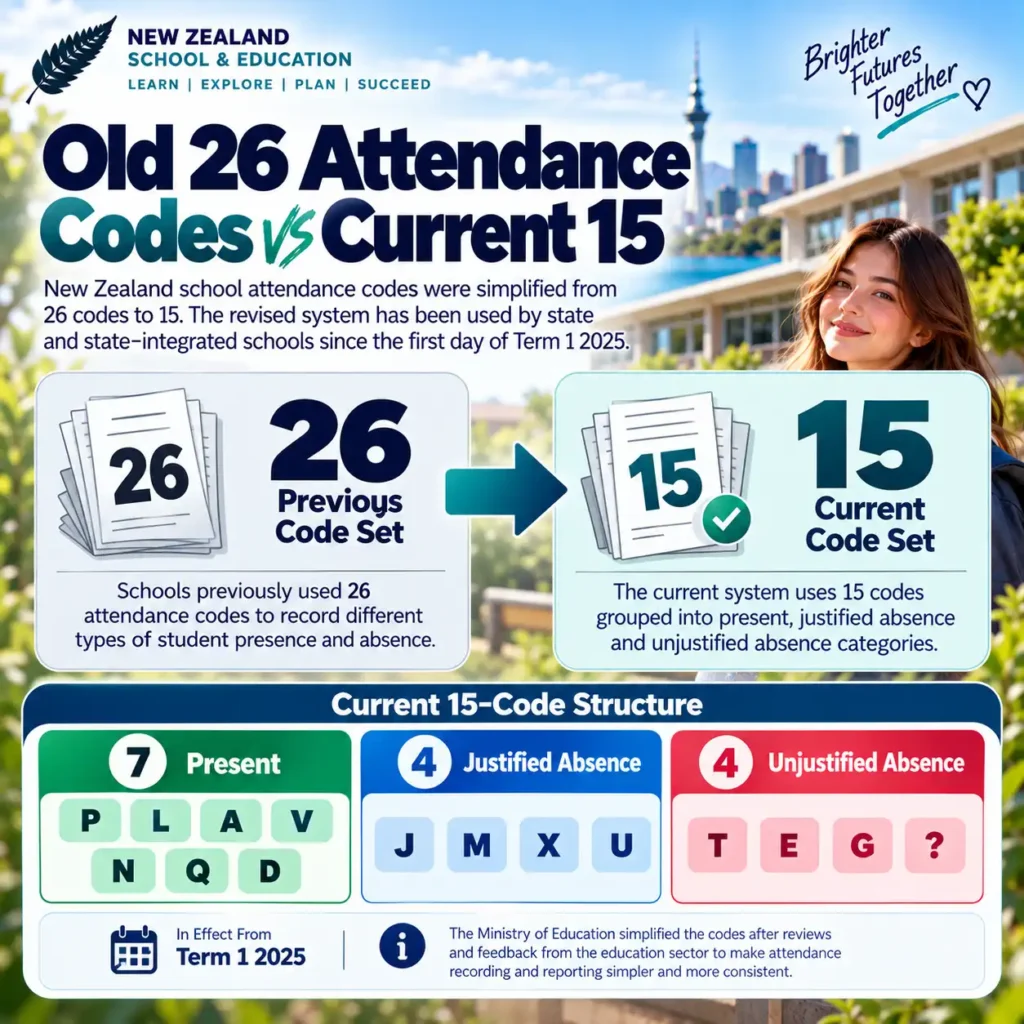
Why NZ Attendance Codes Were Simplified
New Zealand’s attendance codes were reviewed and simplified to make attendance recording easier to administer and improve consistency in attendance data.
The Main Reason for the Change
Previous reviews and feedback from the education sector identified a need for simpler attendance codes. The Ministry of Education reduced the number of codes from 26 to 15 so they would be easier to administer and support more consistent recording and reporting.
Simpler Recording
Fewer codes make it easier for schools to identify the appropriate attendance category.
Consistent Data
The revised system supports more consistent attendance recording and reporting across schools.
Clearer Categories
The current system clearly separates present, justified absence and unjustified absence codes.
A Simpler Attendance Decision Process
The Ministry’s attendance decision tree uses these questions to help determine which of the 15 current codes applies.
What Schools Should Know
- The current system contains 15 attendance codes.
- Eleven previous codes were discontinued and merged into existing categories.
- No new attendance codes were created during the change.
- The revised codes have been in use from the first day of Term 1 2025.
- Schools should follow the current Ministry guidance when applying codes.
Simplified Does Not Mean Every Situation Is the Same
The 15-code system provides standard categories, but the correct code still depends on the circumstances of the student’s attendance or absence. Schools should use the Ministry’s detailed code guidance and decision tree rather than choosing a code based only on the general category.
The Current 15-Code Structure
P · L · A · V · N · Q · D
J · M · X · U
T · E · G · ?
For the latest definitions and attendance-code guidance, use the Ministry of Education’s official attendance codes page.
Official NZ Attendance CodesCommon Questions About NZ School Attendance Codes
Find quick answers to common questions about the 15 current New Zealand school attendance codes, justified absences, unjustified absences and attendance reporting.
How many NZ school attendance codes are there?
What does P mean on a school attendance record?
What does L mean in NZ school attendance?
What does M mean on a NZ attendance record?
What does J mean in school attendance?
What does X mean in NZ school attendance?
What does T mean in NZ school attendance?
What does E mean in school attendance?
What does G mean in NZ school attendance?
What does the ? attendance code mean?
Which attendance codes count as present?
Which attendance codes are unjustified absences?
Does X count toward Ministry attendance calculations?
When did the current 15 attendance codes start?
Where can I check the official NZ attendance codes?
View the official Ministry attendance codes →
Important: An attendance code should be selected according to the circumstances of the student’s attendance or absence and the current Ministry guidance. School policies can also affect how certain situations are recorded.
Understanding NZ School Attendance Codes
New Zealand schools currently use 15 attendance codes to record student attendance and absence. The system replaced the previous 26-code system from Term 1 2025.
The codes are grouped into present, justified absence and unjustified absence categories. Understanding the meaning of each code can make school attendance records easier to read and explain.
Remember
The correct attendance code depends on the circumstances of the student’s attendance or absence. Schools should follow the current Ministry of Education guidance and their applicable attendance procedures when recording attendance.