
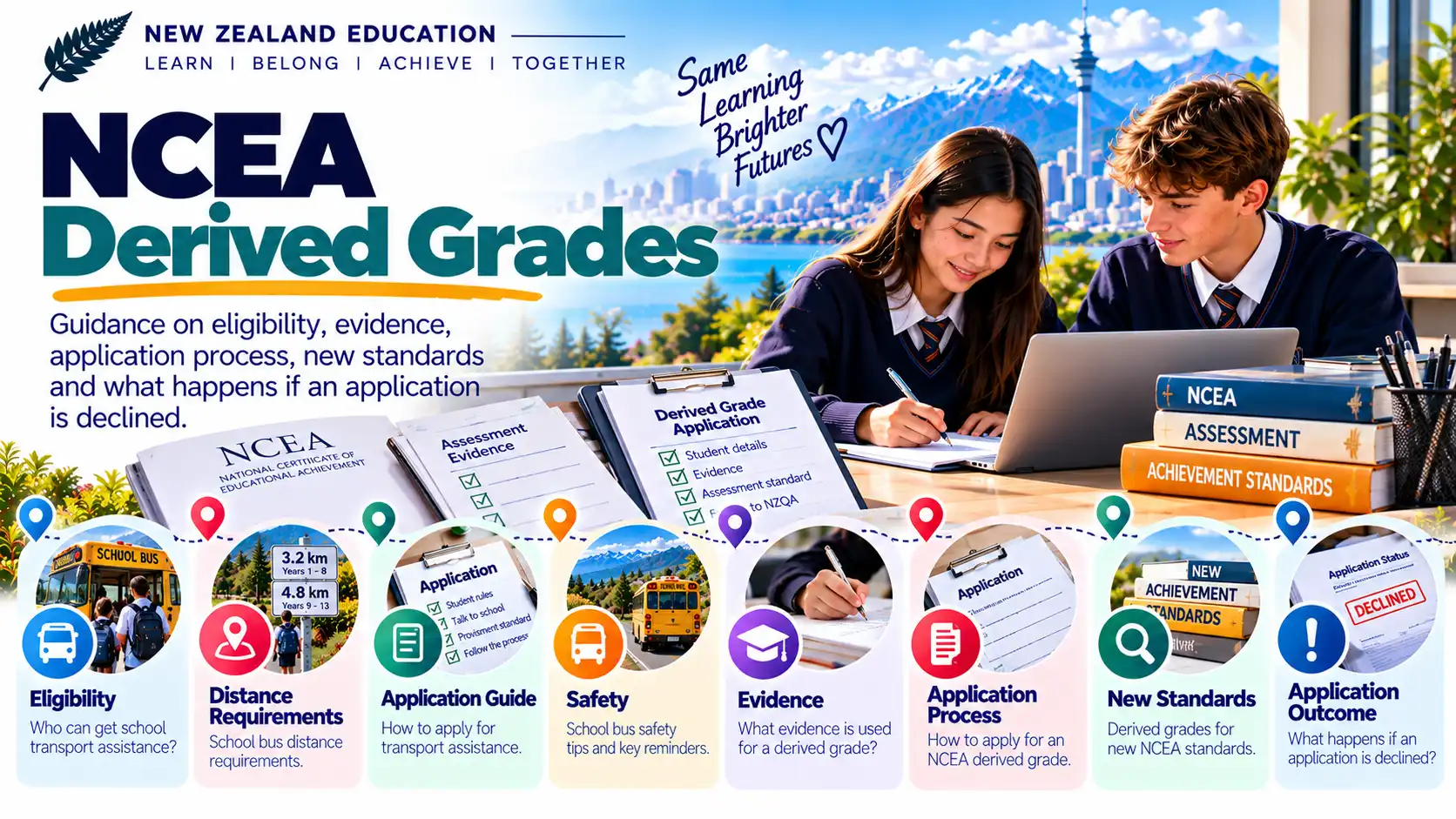
NCEA Derived Grades
An NCEA derived grade may help an eligible student when an unexpected event, illness, injury or other approved circumstance affects their ability to complete an eligible assessment.
Learn How It WorksWhat Is an NCEA Derived Grade?
A derived grade is a grade that can be awarded in certain circumstances when a student’s performance in an eligible assessment has been affected by an approved event or circumstance.
The process is based on evidence already available to the school. The evidence needs to meet NZQA requirements and be suitable for the assessment standard.
It Has Specific Eligibility Rules
A derived grade is not automatically available whenever a student misses an assessment. Specific NZQA requirements apply.
Evidence Is Important
Schools use appropriate pre-existing evidence to determine the grade that can be submitted under the derived-grade process.
The School Manages the Application
Students normally work through their school, with the school’s Principal’s Nominee managing the application process with NZQA.
A derived grade is not a replacement for normal preparation or a general way to improve an NCEA result. Eligibility, assessment type and evidence requirements all matter.
When Can a Student Get a Derived Grade?
A derived grade is available only in specific circumstances. The student must meet NZQA requirements, and the assessment must be one for which the derived-grade process applies.
Medical Reason
A temporary illness or injury may affect a student’s ability to complete an eligible external assessment or significantly affect their performance. Appropriate evidence is required.
Significant Event
A significantly disturbing or distressing event may qualify when it affects the student’s ability to complete the assessment or their performance in it.
National Representation
A student selected to represent New Zealand by a registered national body may be eligible. NZQA requirements and pre-approval rules apply.
A derived grade is not simply for a student who missed preparation time, did not study, or wants to improve a result. NZQA eligibility requirements must be met.
Eligibility depends on more than the reason
The reason for the application is only one part of the process. The assessment itself and the evidence available to the school also matter.
The student’s situation must fall within an eligible NZQA category.
The assessment must be one for which derived grades are available.
The school must have appropriate evidence that can support the grade.
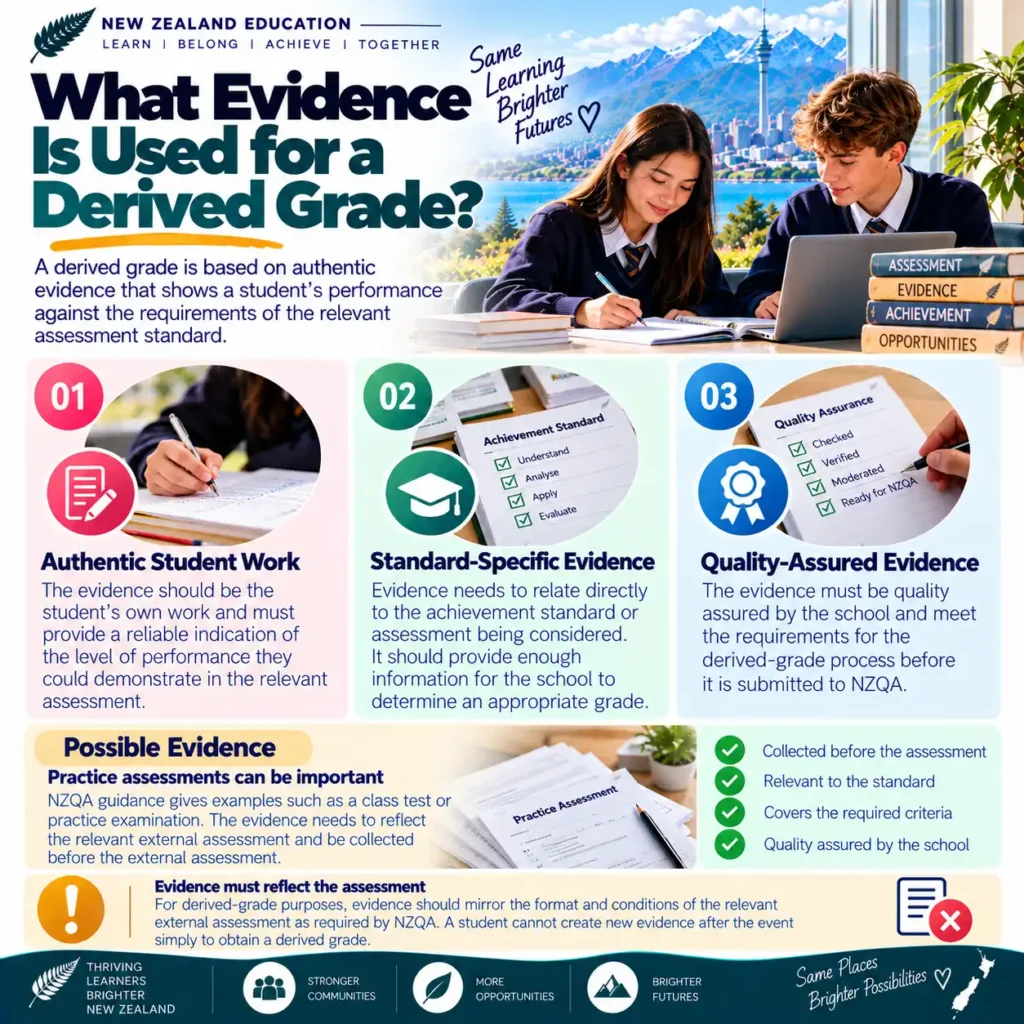
What Evidence Is Used for a Derived Grade?
A derived grade is based on authentic evidence that shows a student’s performance against the requirements of the relevant assessment standard.
Authentic Student Work
The evidence should be the student’s own work and must provide a reliable indication of the level of performance they could demonstrate in the relevant assessment.
Standard-Specific Evidence
Evidence needs to relate directly to the achievement standard or assessment being considered. It should provide enough information for the school to determine an appropriate grade.
Quality-Assured Evidence
The evidence must be quality assured by the school and meet the requirements for the derived-grade process before it is submitted to NZQA.
For derived-grade purposes, evidence should mirror the format and conditions of the relevant external assessment as required by NZQA. A student cannot create new evidence after the event simply to obtain a derived grade.
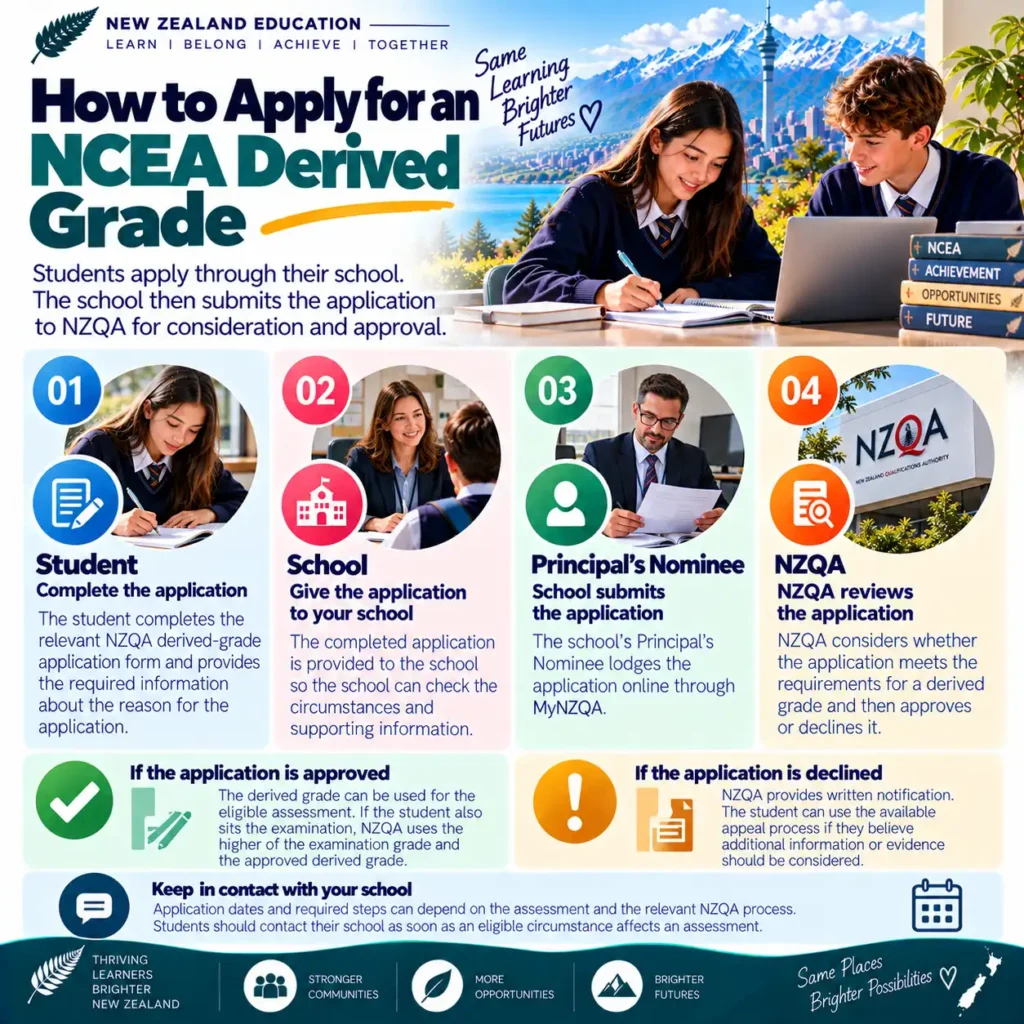
How to Apply for an NCEA Derived Grade
Students apply through their school. The school then submits the application to NZQA for consideration and approval.
Complete the application
The student completes the relevant NZQA derived-grade application form and provides the required information about the reason for the application.
Give the application to your school
The completed application is provided to the school so the school can check the circumstances and supporting information.
School submits the application
The school’s Principal’s Nominee lodges the application online through MyNZQA.
NZQA reviews the application
NZQA considers whether the application meets the requirements for a derived grade and then approves or declines it.
If the application is approved
The derived grade can be used for the eligible assessment. If the student also sits the examination, NZQA uses the higher of the examination grade and the approved derived grade.
If the application is declined
NZQA provides written notification. The student can use the available appeal process if they believe additional information or evidence should be considered.
Application dates and required steps can depend on the assessment and the relevant NZQA process. Students should contact their school as soon as an eligible circumstance affects an assessment.
What Happens If You Still Sit the Exam?
An approved derived grade does not prevent a student from sitting the relevant examination. If the student completes the exam, NZQA uses the higher result.
You can still sit the examination
If your circumstances improve and you are able to complete the assessment, you can sit the examination where appropriate.
There is no need to choose in advance
An approved derived grade can remain relevant even if the student is later able to sit the examination.
The exam result is considered
If the student sits the assessment, the examination result is compared with the approved derived grade.
The higher result is used
NZQA uses the higher of the examination grade and the approved derived grade for the relevant assessment.
NZQA guidance encourages students to sit examinations whenever they are able to do so. The examination result can provide the higher grade when it is above the approved derived grade.
Medical Reasons, Significant Events & National Representation
NZQA recognises specific circumstances that may prevent a student from completing an eligible assessment or significantly affect their performance. The circumstances must meet the relevant requirements.
Illness or Injury
A temporary acute illness or injury may be considered when it prevents the student from completing the assessment or significantly affects their performance.
Distressing or Significant Events
A significantly disturbing or distressing event may qualify when it has an impact on the student’s ability to complete the assessment or their performance.
National Representation
Students selected by a registered national body to represent New Zealand in an eligible national team may be considered under the derived-grade process.
Selection must meet NZQA’s requirements. Invitational teams and teams selected through ordinary competition do not automatically meet the national-representation requirement. Pre-approval is required.
What if a long-term condition becomes significantly worse?
NZQA guidance distinguishes between an ongoing condition and a significant change that affects a student around the assessment period.
A sudden significant change in a chronic illness may be considered.
The circumstance must affect the student’s assessment performance.
Supporting evidence must meet the relevant NZQA requirements.
Having one of these circumstances does not by itself guarantee approval. NZQA considers the application, the assessment involved and the supporting evidence before making a decision.
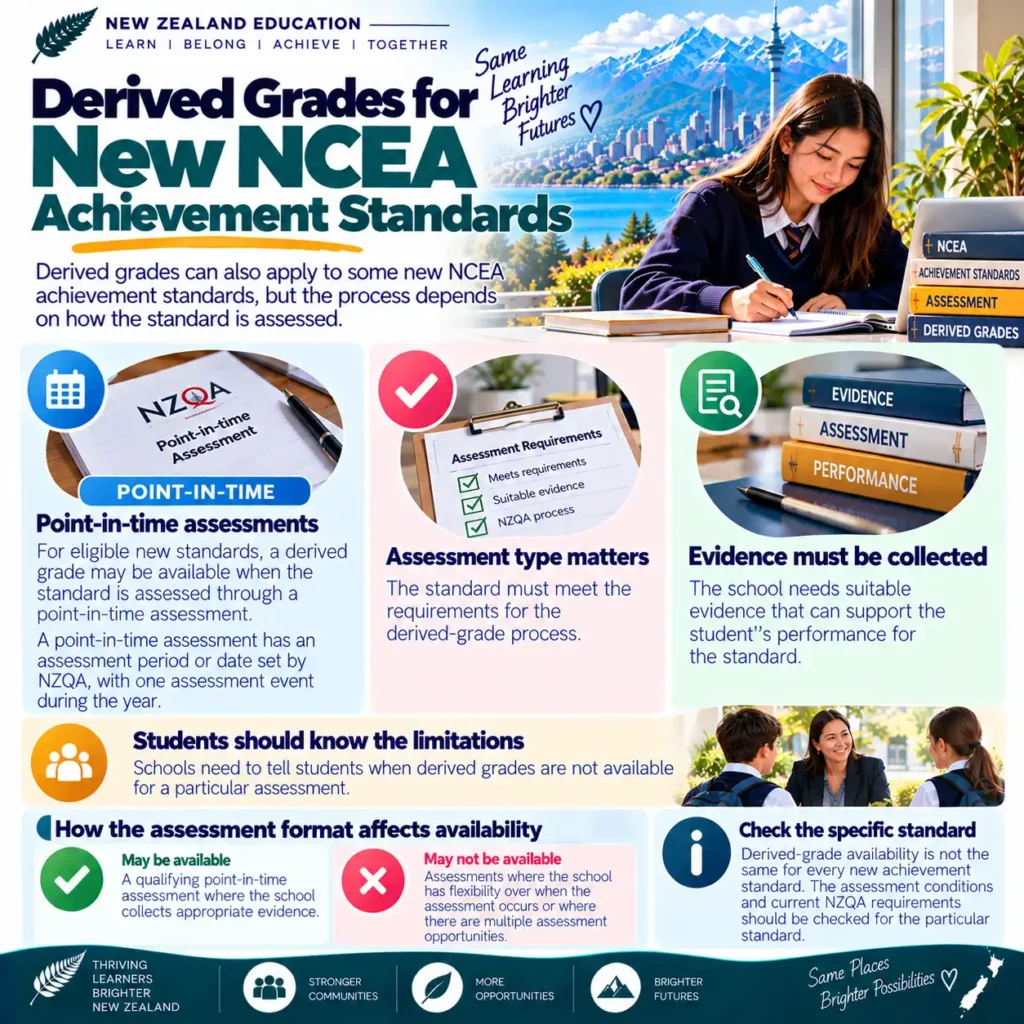
Derived Grades for New NCEA Achievement Standards
Derived grades can also apply to some new NCEA achievement standards, but the process depends on how the standard is assessed.
Point-in-time assessments
For eligible new standards, a derived grade may be available when the standard is assessed through a point-in-time assessment.
A point-in-time assessment has an assessment period or date set by NZQA, with one assessment event during the year.
The standard must meet the requirements for the derived-grade process.
The school needs suitable evidence that can support the student’s performance for the standard.
Schools need to tell students when derived grades are not available for a particular assessment.
May be available
A qualifying point-in-time assessment where the school collects appropriate evidence.
May not be available
Assessments where the school has flexibility over when the assessment occurs or where there are multiple assessment opportunities.
Derived-grade availability is not the same for every new achievement standard. The assessment conditions and current NZQA requirements should be checked for the particular standard.
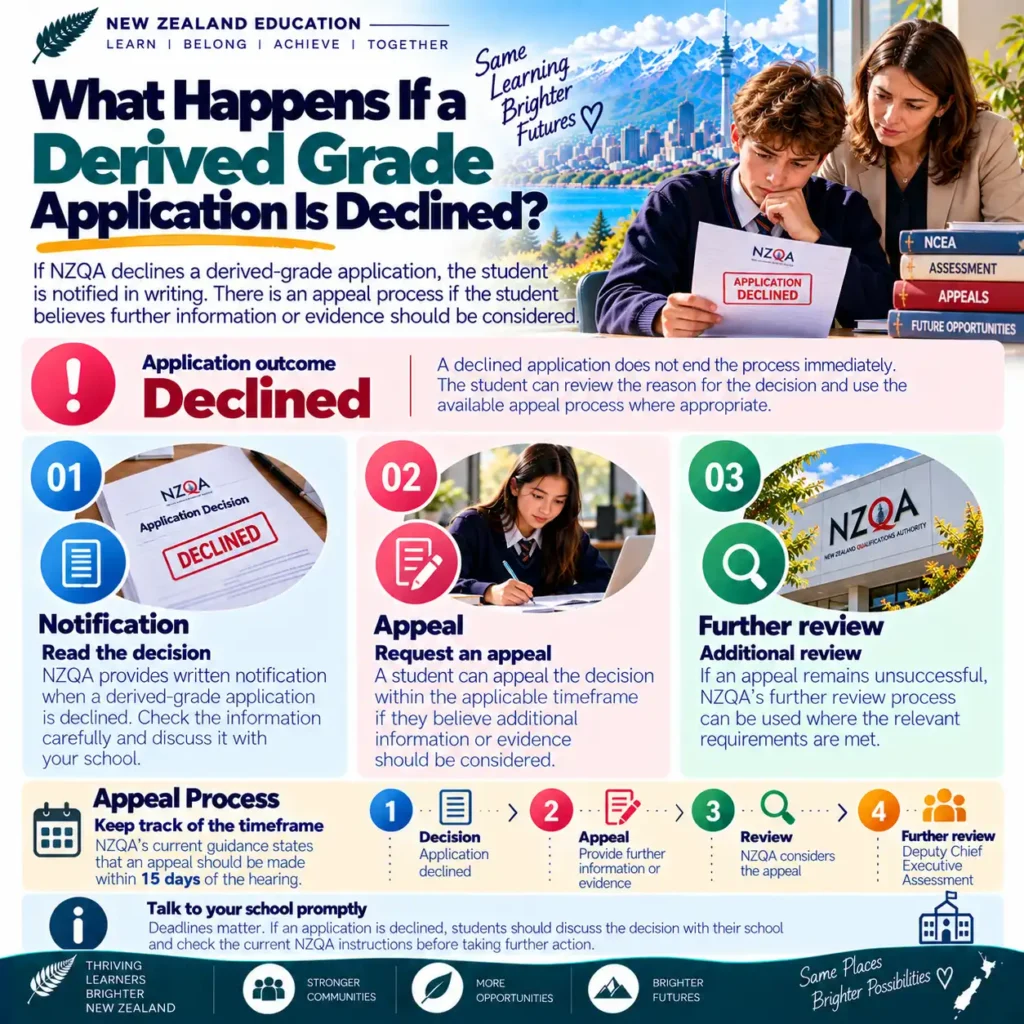
What Happens If a Derived Grade Application Is Declined?
If NZQA declines a derived-grade application, the student is notified in writing. There is an appeal process if the student believes further information or evidence should be considered.
A declined application does not end the process immediately. The student can review the reason for the decision and use the available appeal process where appropriate.
Read the decision
NZQA provides written notification when a derived-grade application is declined. Check the information carefully and discuss it with your school.
Request an appeal
A student can appeal the decision within the applicable timeframe if they believe additional information or evidence should be considered.
Additional review
If an appeal remains unsuccessful, NZQA’s further review process can be used where the relevant requirements are met.
Keep track of the timeframe
NZQA’s current guidance states that an appeal should be made within 15 days of the hearing.
Deadlines matter. If an application is declined, students should discuss the decision with their school and check the current NZQA instructions before taking further action.
Derived Grades vs Other NCEA Assessment Support
A derived grade is one specific NZQA process. It should not be confused with other forms of assessment support that may apply in different circumstances.
Evidence is used to establish a grade
The focus is on an approved circumstance and reliable evidence that demonstrates the student’s performance for the relevant assessment.
Support is provided during assessment
Special Assessment Conditions are designed for eligible students whose assessment needs require approved adjustments or support.
A long-term or recurring condition does not automatically mean that a derived grade is the appropriate process. In some circumstances, Special Assessment Conditions may be more relevant. A significant change or exacerbation close to an assessment may be considered under the derived-grade rules when the requirements are met.
Common Mistakes & Misunderstandings About Derived Grades
Derived grades have specific rules. Understanding what the process can and cannot do can help students and families avoid common misunderstandings.
“A missed exam automatically means I get a derived grade.”
Not necessarily. The student must meet the relevant eligibility requirements, the assessment must be eligible, and suitable evidence must be available.
“I can use a derived grade because I did not have enough time to study.”
No. Derived grades are not intended to make up for missed learning, preparation time or lack of study.
“I should not sit the exam if I have an approved derived grade.”
Not necessarily. If the student is able to sit the exam, the examination result can still be used. When the derived grade is approved, the higher of the exam grade and derived grade is used.
“My school can decide whether I qualify.”
NZQA makes the approval decision. The school manages the application and submits it to NZQA, which considers the eligibility and evidence.
“I can create evidence after the assessment if I need a derived grade.”
No. Derived-grade evidence needs to be appropriate, authentic, standard-specific and collected before the relevant external assessment.
“National representation automatically qualifies me.”
Specific requirements apply. National representation must meet NZQA’s criteria, and pre-approval is required for eligible representation circumstances.
A derived grade is an evidence-based NZQA process with specific eligibility rules. Students should speak with their school as soon as an eligible circumstance affects an assessment.
FAQs About NCEA Derived Grades
These answers cover common questions about eligibility, evidence, applications, examinations and derived-grade results.
What is an NCEA derived grade? +
A derived grade is an evidence-based grade that may be available when an eligible circumstance prevents a student from completing an eligible assessment or significantly affects their performance.
Who can apply for a derived grade? +
A student who has an eligible circumstance can apply through their school. NZQA then considers whether the requirements for a derived grade have been met.
What circumstances can qualify for a derived grade? +
NZQA identifies circumstances including eligible medical reasons, significantly disturbing or distressing events, and qualifying national representation. Specific requirements apply to each circumstance.
What evidence is needed for a derived grade? +
The evidence must be authentic, relevant to the assessment standard, quality assured and suitable for determining the student’s performance. NZQA guidance includes examples such as class tests and practice examinations.
Can I get a derived grade because I did not study enough? +
No. Derived grades are not intended to compensate for missed learning, preparation time or lack of study.
Can I still sit my exam after getting a derived grade? +
Yes, where the assessment and circumstances allow the student to sit the examination. If the derived grade has been approved, NZQA uses the higher of the examination grade and the derived grade.
Who submits the derived-grade application to NZQA? +
The student completes the relevant application and gives it to the school. The school’s Principal’s Nominee lodges the application online through MyNZQA.
Does NZQA approve every derived-grade application? +
No. NZQA considers the student’s circumstances, the assessment and supporting evidence before deciding whether the application meets the requirements.
What happens if my derived-grade application is declined? +
NZQA provides written notification. The student can use the applicable appeal process and provide further information or evidence where appropriate.
Do national representation students automatically qualify? +
No. National representation must meet NZQA’s requirements, and pre-approval is required. Not every team or event meets the national-representation criteria.
Can derived grades apply to new NCEA achievement standards? +
They may apply to eligible new standards assessed through a qualifying point-in-time assessment. Availability depends on the assessment conditions and current NZQA requirements for the standard.
Is a derived grade the same as Special Assessment Conditions? +
No. A derived grade is an evidence-based grade process for eligible circumstances. Special Assessment Conditions provide approved support or adjustments for eligible students during assessment.
Derived-grade rules, assessment requirements and application dates can change. Students should check the current NZQA guidance and speak with their school about their individual situation.
Understanding NCEA Derived Grades
An NCEA derived grade is a specific NZQA process for eligible students whose circumstances affect their ability to complete an eligible assessment or significantly affect their performance.
The process depends on the student’s circumstances, the assessment involved and the quality of the evidence available to the school. Students apply through their school, and NZQA makes the final decision.
If an approved derived grade is available and the student also sits the examination, the higher of the examination grade and the derived grade is used.
Eligibility rules apply.
Suitable evidence is required.
The school manages the application.
NZQA makes the approval decision.
Current NZQA requirements should be checked.
Talk to your school as soon as possible. Your school can explain the relevant process, evidence requirements and current NZQA deadlines for your assessment.