

Percentage Calculator NZ
Calculate percentages, marks, increases and decreases quickly.
Use our Percentage Calculator NZ to work out percentages from marks, find what percentage one number is of another, and calculate percentage increases or decreases. It is designed to make everyday school, study, and assessment calculations simple.
Table of Contents
Jump to the section you need.
Percentage Calculator
Choose the calculation you need. Enter your numbers and get your percentage result instantly.
What is X% of Y?
Find a specific percentage of a number.
What Percentage Is X of Y?
Find what percentage one number represents of another number.
Marks to Percentage
Convert marks from a test, assignment, quiz, or exam into a percentage.
Percentage Increase or Decrease
Compare an original value with a new value to calculate the percentage change.
What Is a Percentage?
A percentage shows a number as a part of 100. The word percentage means “per hundred”, and the symbol used is %.
How Does Percentage Calculation Work?
Percentage calculations are useful when you want to compare an amount with a total. Students often use percentages for test marks, assignments, quizzes, exams, attendance, and other results.
For example, if you receive 36 marks from a possible 40 marks, divide 36 by 40 and multiply by 100.
Three Common Percentage Questions
1. What Is X% of Y?
Find a percentage of a number.
20% of 150 = 302. What % Is X of Y?
Find what percentage one number represents.
42 of 50 = 84%3. Marks to Percentage
Convert an assessment score into a percentage.
36 of 40 = 90%Why Are Percentages Useful for Students?
Percentages make different results easier to compare. A test marked out of 20 and another marked out of 50 can be expressed using the same percentage scale.
For example, 16 out of 20 and 40 out of 50 both equal 80%. This makes percentage results easier to understand across assessments.
Percentage Does Not Always Mean an Official Grade
A percentage is a mathematical result. It does not automatically tell you the official grade given by your school or education provider.
Different schools, courses, and assessments may use different grading and reporting methods. In New Zealand, NCEA achievement standards also use standards-based assessment rather than one universal percentage scale.
Use this calculator to understand your numbers and assessment results. If you need your official grade or NCEA result, check the grading information provided by your school or NZQA.
How to Calculate Marks as a Percentage
Converting marks into a percentage is one of the most common uses of a percentage calculator. It can help you understand your result when a test, assignment, quiz, or exam is marked out of a different total.
You only need two numbers: the marks you earned and the total marks available.
The Marks to Percentage Formula
First, divide your marks by the total marks. Then multiply the result by 100 to convert it into a percentage.
Example: 42 Out of 50
42 ÷ 50 = 0.84
Step 2: Multiply by 1000.84 × 100 = 84
Answer: 84%Examples With Different Total Marks
Your total does not have to be 100. The same formula works for almost any positive total.
| Marks Earned | Total Marks | Percentage |
|---|---|---|
| 9 | 10 | 90% |
| 16 | 20 | 80% |
| 36 | 40 | 90% |
| 42 | 50 | 84% |
| 60 | 75 | 80% |
| 72 | 80 | 90% |
| 85 | 100 | 85% |
Why Your Test Does Not Need to Be Out of 100
A common mistake is thinking that a test must be marked out of 100 to calculate a percentage. It does not.
For example, 18 out of 25 can be converted into a percentage: 18 ÷ 25 × 100 = 72%.
This allows students to compare results from assessments with different maximum marks.
Common Marks to Percentage Mistakes
Using the wrong total
Make sure you use the maximum marks for that specific assessment, not the total from another test or assignment.
Forgetting to multiply by 100
Dividing the marks gives a decimal. Multiply by 100 to express that result as a percentage.
Confusing percentage with grade
A calculated percentage does not automatically determine your school's official grade.
Ignoring assessment weighting
If several assessments contribute different amounts to your course, you may need a weighted calculation instead.
A percentage can help you understand an assessment result, but schools may use different grading and reporting methods. For NCEA assessments, official grades are based on the requirements and marking of the relevant standard rather than a single universal percentage scale.

Percentage Increase and Decrease
Percentage change shows how much a value has increased or decreased compared with its original value. It is useful for comparing two numbers, results, prices, scores, or other measurements.
Percentage Change Formula
The original value is the starting point. The new value is the value after the change.
Example: Percentage Increase
From 80 to 100
First find the difference: 100 − 80 = 20.
Then divide by the original value: 20 ÷ 80 = 0.25.
Finally multiply by 100: 0.25 × 100 = 25%.
Result: 25% increaseExample: Percentage Decrease
From 100 to 80
First find the difference: 80 − 100 = −20.
Compare that change with the original value of 100.
−20 ÷ 100 × 100 = −20%.
Result: 20% decreaseHow to Calculate Percentage Change
- Identify the original value.
- Identify the new value.
- Subtract the original value from the new value.
- Divide the difference by the original value.
- Multiply the result by 100.
Increase vs Decrease
Percentage Increase
The new value is higher than the original value.
50 → 60 = 20% increasePercentage Decrease
The new value is lower than the original value.
60 → 50 = 16.67% decreasePercentage Change in Student Results
Students can use percentage change to compare results over time. For example, you might compare an earlier test score with a later score to see how much the numerical result changed.
Remember that percentage change and percentage-point change are different. If a result moves from 70% to 80%, the increase is 10 percentage points. The percentage increase relative to 70% is about 14.29%.
Percentage change uses the original value as the reference point. If the original value is zero, a standard percentage-change calculation cannot be performed because division by zero is not defined.
What Percentage Do I Need?
Sometimes you already know your current result and want to find out what mark you need to reach a target percentage. This can be useful when planning for a final test, assignment, or exam.
When Can You Calculate a Required Percentage?
You can calculate a required mark when you know how much the remaining assessment contributes to your overall result.
For example, suppose your current result is 80% and your final assessment is worth 30% of the overall result. You can calculate the mark needed to reach a chosen target.
Required Mark Formula
Enter the final weight as a decimal. For example, 30% becomes 0.30.
Example: Reaching an 85% Overall Result
Current result: 80%
Final assessment weighting: 30%
Target overall result: 85%
The completed work contributes 70% of the overall result.
80 × 0.70 = 56
The remaining 29 points must come from the final assessment.
29 ÷ 0.30 = 96.67
Required final mark: 96.67%How to Work Out the Required Mark
- Write down your current percentage.
- Find the weighting of the remaining assessment.
- Choose your target overall percentage.
- Enter these values into the relevant calculator.
- Check whether the required result is within the possible range.
What If the Required Mark Is Over 100%?
If the required mark is greater than 100%, the target is not mathematically achievable under the numbers entered.
For example, if the calculator says you need 105%, there is no possible mark from 0% to 100% that can produce that target.
What If You Have Already Reached Your Target?
If your current result is already enough to reach the target, you may need 0% or less on the remaining assessment to meet that target, depending on the weighting.
A result below 0% is not a realistic assessment mark. It means the target has already been reached based on the values entered.
Target Is Achievable
Current result: 75%
Final assessment: 20%
Target: 80%
Required mark: 95%Target Is Not Achievable
Current result: 70%
Final assessment: 20%
Target: 90%
Required mark: 170%This calculation assumes the current percentage and assessment weighting are correct. Your school or course may use different rules, especially where assessments have specific grading requirements.

Percentage Calculator for Students
Students can use a percentage calculator to check test marks, assignment results, exam scores, and other numerical results. It can also help when comparing results from assessments with different maximum marks.
How Students Can Use a Percentage Calculator
Test Results
Convert marks from a class test into a percentage and see how the numerical result compares with the total marks.
Assignments
Calculate the percentage from an assignment score when the assessment is marked out of a specific number.
Exam Scores
Convert an exam result into a percentage when you know the marks earned and the maximum available marks.
Compare Assessments
Express different assessment results as percentages to make numerical comparisons easier.
Track Progress
Compare numerical results from different assessments over time.
Target Planning
Use percentage calculations to understand the mark you may need when working towards a numerical target.
Example: Checking a Test Result
Divide 34 by 40: 34 ÷ 40 = 0.85
Multiply by 100: 0.85 × 100 = 85
Test result: 85%Example: Comparing Two Assessments
Imagine a student receives 16 out of 20 on one assessment and 40 out of 50 on another.
Assessment 1
16 ÷ 20 × 100
80%Assessment 2
40 ÷ 50 × 100
80%Comparison
Both assessments produced the same percentage result.
80%Useful Checks Before Calculating
- Check that you have entered the marks you actually received.
- Confirm the total marks for the correct assessment.
- Make sure you are not using a weighting instead of the assessment total.
- Check whether your course uses percentages, weighted results, or another assessment method.
- Keep the original assessment information so you can verify the result.
For NZ School Students
A percentage can be useful for understanding a numerical assessment result, but it may not represent the complete way your school reports progress or achievement.
New Zealand schools can use different assessment and reporting approaches. NCEA assessments also use standards-based assessment, so a percentage should not automatically be treated as an official NCEA grade.
The Percentage Calculator helps with the mathematics behind your result. For your official school grade, assessment result, or NCEA outcome, follow the information provided by your school or the relevant official NZQA guidance.
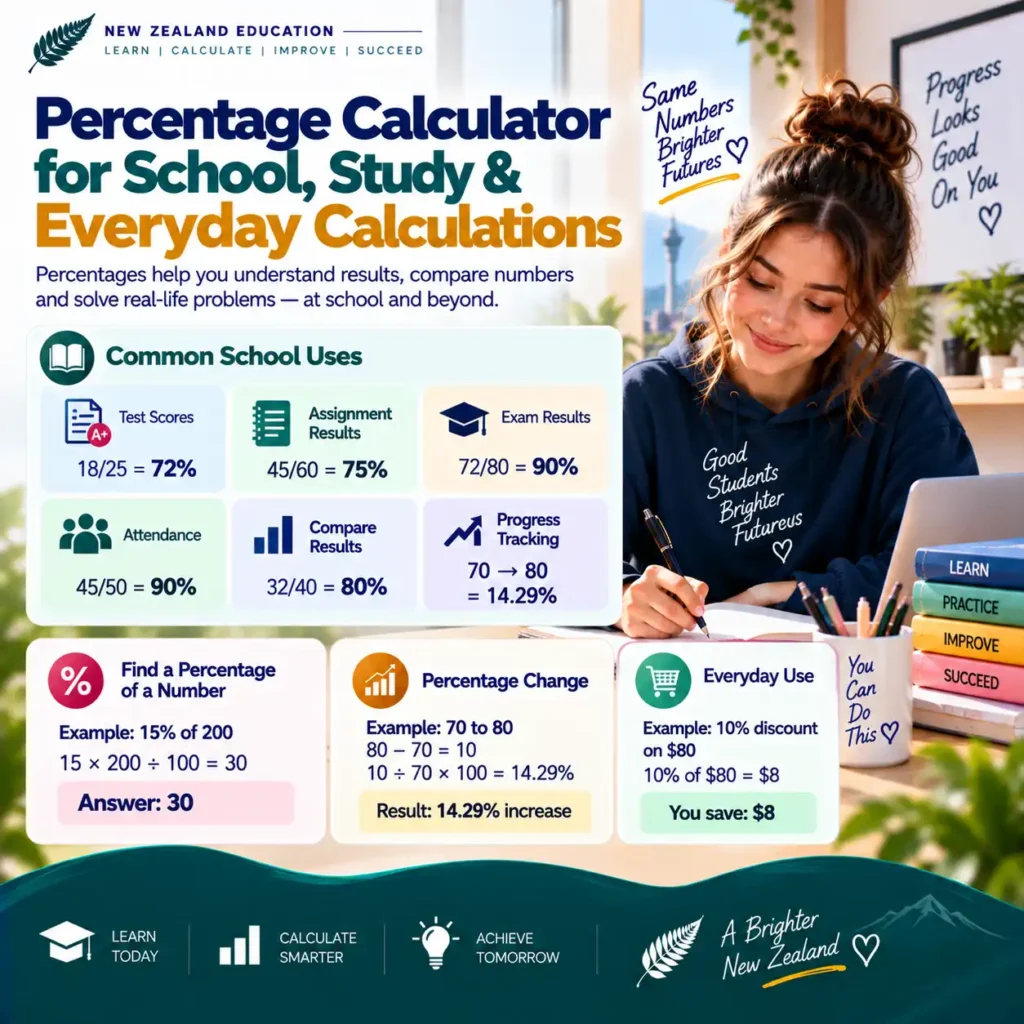
Percentage Calculator for School, Study & Everyday Calculations
Percentages are useful in many situations beyond converting test marks. Students can use them to understand changes, compare numbers, and solve everyday calculation problems.
Common School Uses
Test Scores
Convert a score such as 18 out of 25 into a percentage.
18/25 = 72%Assignment Results
Find the percentage from marks received on an assignment.
45/60 = 75%Exam Results
Turn an exam score into a percentage when the maximum marks are known.
72/80 = 90%Attendance
Percentage calculations can help express attended sessions compared with total sessions.
45/50 = 90%Assessment Comparison
Convert different assessment totals into percentages for easier numerical comparison.
32/40 = 80%Progress Tracking
Compare an earlier numerical result with a later result to calculate percentage change.
70 → 80 = 14.29%Finding a Percentage of a Number
You can also use percentages to find a portion of a number. This is useful in maths exercises and everyday calculations.
15 × 200 ÷ 100 = 30
Answer: 30Percentage Change in Study Results
Percentage change can show how a numerical result has changed between two assessments.
Change = 80 − 70 = 10
10 ÷ 70 × 100 = 14.29%
Result: 14.29% increaseEveryday Percentage Calculations
Percentage calculations can also appear outside school. For example, you may need to calculate a discount, compare two values, or find a portion of a total.
Discounts
Find the numerical amount represented by a percentage discount.
10% of $80 = $8Comparisons
Find what percentage one quantity represents of another.
25 of 100 = 25%Changes
Measure how much a value has increased or decreased from its original amount.
100 → 120 = 20% increasePercentage Points vs Percentage Change
These two terms should not be confused. Percentage points describe the direct difference between two percentages.
The direct difference is 10 percentage points.
The percentage increase relative to the original 70% is: 10 ÷ 70 × 100 = 14.29%.
10 percentage points ≠ 10% increaseChoose the calculation that matches the question. Use “What is X% of Y?” for a percentage of a number, “What % is X of Y?” for a ratio expressed as a percentage, and Percentage Change when comparing an original value with a new value.
Practical Percentage Calculation Examples
These examples show how percentage calculations work in common school, study, and everyday situations. You can use the calculator above to check each result.
Example 1: Test Marks
A student scores 36 out of 40.
Step 1: 36 ÷ 40 = 0.90
Step 2: 0.90 × 100 = 90
Result: 90%Example 2: Assignment Marks
A student receives 45 out of 60.
45 ÷ 60 × 100 = 75
Result: 75%Example 3: Finding a Percentage of a Number
What is 25% of 240?
25 × 240 ÷ 100 = 60
Answer: 60Example 4: Finding What Percentage One Number Is
What percentage is 18 out of 24?
18 ÷ 24 × 100 = 75
Result: 75%Example 5: Percentage Increase
A numerical result increases from 60 to 72.
Change = 72 − 60 = 12
12 ÷ 60 × 100 = 20
Result: 20% increaseExample 6: Percentage Decrease
A value decreases from 80 to 68.
Change = 68 − 80 = −12
12 ÷ 80 × 100 = 15
Result: 15% decreaseExample 7: Comparing Two Assessment Results
| Assessment | Marks | Calculation | Percentage |
|---|---|---|---|
| Test A | 18 / 20 | 18 ÷ 20 × 100 | 90% |
| Test B | 42 / 50 | 42 ÷ 50 × 100 | 84% |
| Assignment | 72 / 80 | 72 ÷ 80 × 100 | 90% |
| Quiz | 16 / 25 | 16 ÷ 25 × 100 | 64% |
Example 8: Percentage Points vs Percentage Change
A result moves from 70% to 80%.
Direct difference: 80% − 70% = 10 percentage points.
Percentage change: 10 ÷ 70 × 100 = 14.29%.
Answer: 10 percentage points, or 14.29% increaseWhich Calculation Should You Use?
| Your Question | Use This Calculation |
|---|---|
| What is 20% of 150? | What is X% of Y? |
| 42 is what percentage of 50? | What % is X of Y? |
| I scored 42 out of 50. | Marks to Percentage |
| My result changed from 70 to 80. | Percentage Change |
Before accepting a result, make sure you entered the correct marks, total, original value, and new value. A calculator can only produce a useful result when the input information is correct.
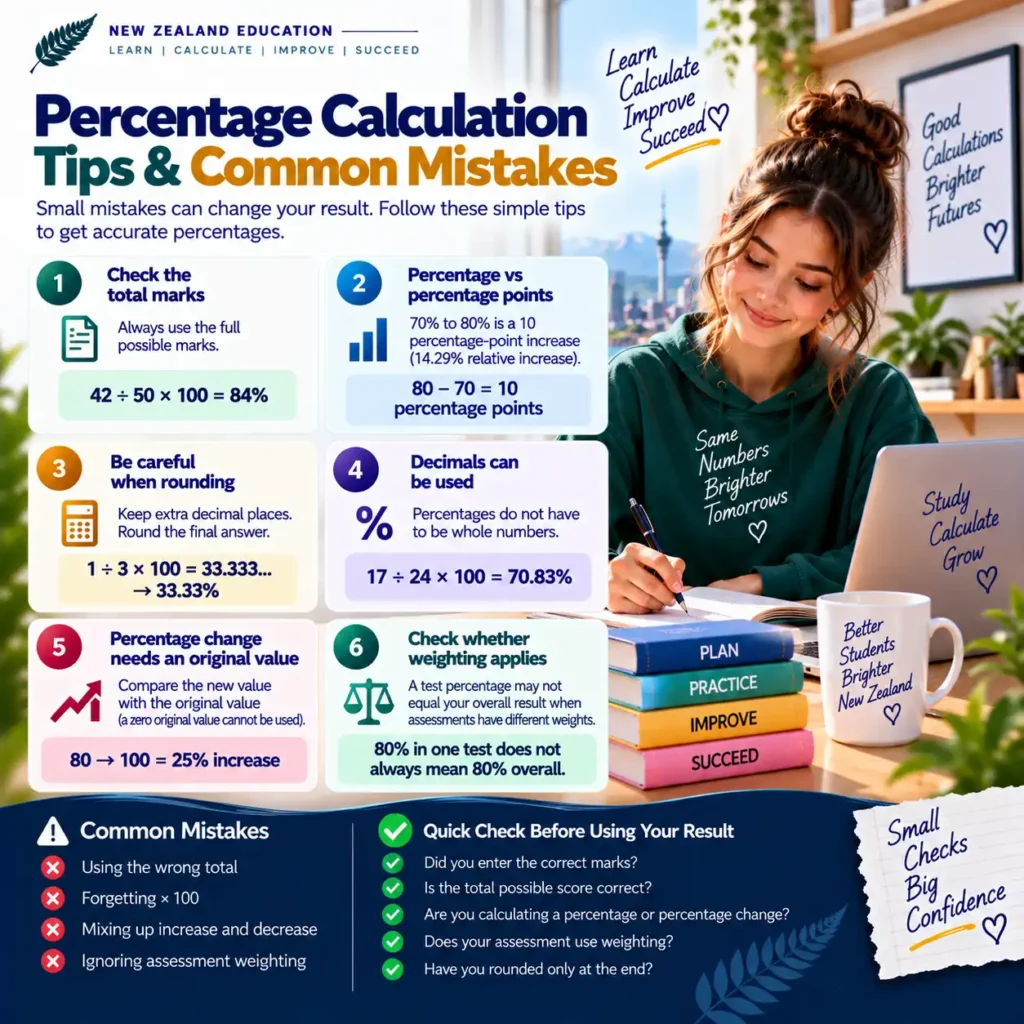
Percentage Calculation Tips & Common Mistakes
Small input mistakes can change your percentage result. These simple tips can help you check your calculation.
1. Check the total marks
Always enter the full possible marks as the total. For example, 42 out of 50 is 84%.
2. Do not confuse percentage with percentage points
A change from 70% to 80% is a 10 percentage-point increase. It is a 14.29% relative increase.
3. Be careful when rounding
Keep extra decimal places during the calculation. Round the final answer only when needed.
4. Decimals can be used
Percentages do not have to use whole numbers. Decimal results can provide a more precise answer.
5. Percentage change needs an original value
Percentage change compares a new value with the original value. A zero original value cannot be used.
6. Check whether weighting applies
A test percentage may not equal your overall course result when assessments have different weights.
Common Percentage Calculation Mistakes
Make sure the denominator is the full possible score.
A decimal such as 0.84 represents 84% when converted to a percentage.
Always compare the new value with the original value.
Weighted assessments require each result and its correct weighting.
Quick Check Before Using Your Result
Before relying on a percentage, check your marks, total, calculation type, and rounding.
- Did you enter the correct marks?
- Is the total possible score correct?
- Are you calculating a percentage or percentage change?
- Does your assessment use weighting?
- Have you rounded only at the end?
Percentage Calculator FAQs
Find quick answers to common questions about percentages, marks, percentage changes, and student calculations.
How do I calculate a percentage?
What is 20% of 150?
How do I calculate my test percentage?
Can I use this percentage calculator for school marks?
How do I calculate percentage increase?
How do I calculate percentage decrease?
What is the difference between percentage and percentage points?
Can I calculate a percentage from marks that are not out of 100?
Does this calculator work with decimal percentages?
Can I use this calculator for NCEA?
Why is my percentage result different from my school grade?
Is this percentage calculator an official NZ school calculator?
Important: Your school, course, or education provider may use its own assessment and grading rules. Use this calculator for mathematical calculations and check official requirements when needed.
Official Sources & Last Updated
Our percentage calculations are mathematical. NZ education information is checked against relevant official sources where applicable.
Ministry of Education
Provides official information about New Zealand schools, curriculum, assessment, reporting, and education policy.
NZQA
Provides official information about NCEA, achievement standards, assessment, grade score marking, and qualifications.
Source Notes
- The percentage formulas used by this calculator are standard mathematical calculations.
- NZ schools and education providers may use their own assessment, grading, weighting, and reporting methods.
- NCEA results are based on NZQA assessment requirements and standard-specific criteria.
- A percentage calculated on this page should not be treated as an official school or NZQA result.
Important: This calculator is provided for general educational and mathematical use. Always check your school's assessment instructions or official NZQA information when an official result or qualification requirement matters.
Convert test, assignment, and exam marks into percentages.
Compare original and new values to find percentage change.
Designed with NZ students, parents, and education users in mind.