
NZ School Curriculum Guide
Jump to the section you need to understand the New Zealand school curriculum, subjects, assessment, and current changes.
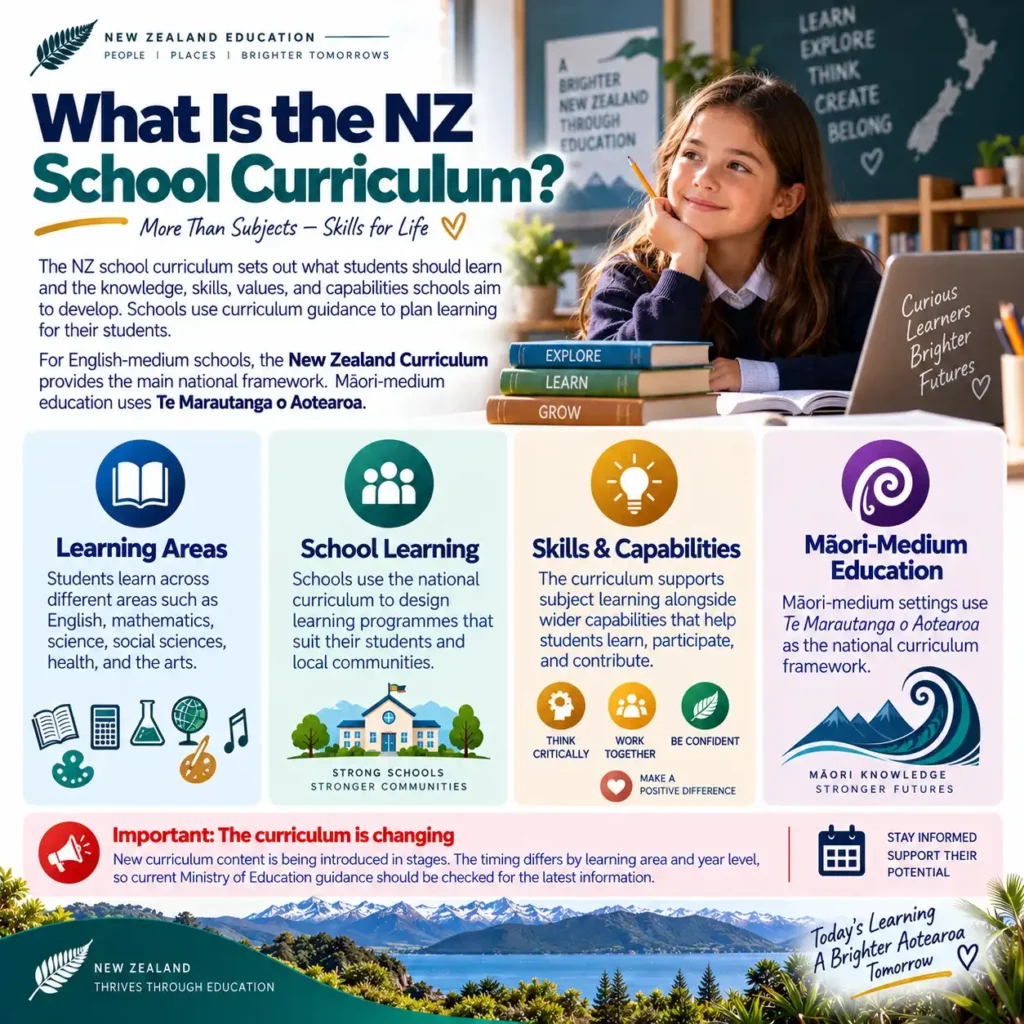
What Is the NZ School Curriculum?
The NZ school curriculum sets out what students should learn and the knowledge, skills, values, and capabilities schools aim to develop. Schools use curriculum guidance to plan learning for their students.
For English-medium schools, the New Zealand Curriculum provides the main national framework. Māori-medium education uses Te Marautanga o Aotearoa.
Learning Areas
Students learn across different areas such as English, mathematics, science, social sciences, health, and the arts.
School Learning
Schools use the national curriculum to design learning programmes that suit their students and local communities.
Skills & Capabilities
The curriculum supports subject learning alongside wider capabilities that help students learn, participate, and contribute.
Māori-Medium Education
Māori-medium settings use Te Marautanga o Aotearoa as the national curriculum framework.
New curriculum content is being introduced in stages. The timing differs by learning area and year level, so current Ministry of Education guidance should be checked for the latest information.
NZ School Curriculum Learning Areas
The New Zealand Curriculum is organised around learning areas. Schools use these areas to plan teaching and learning across different year levels.
English
Reading, writing, speaking, listening, and responding to language and texts.
Mathematics & Statistics
Mathematical thinking, problem-solving, number, measurement, statistics, and related concepts.
Science
Learning about the natural world through scientific knowledge, investigation, and evidence.
Social Sciences
Exploring people, communities, society, places, and how people interact with their world.
The Arts
Creative learning through areas such as visual arts, music, dance, and drama.
Health & Physical Education
Learning about wellbeing, healthy choices, physical activity, relationships, and participation.
Learning Languages
Developing language knowledge and communication through additional languages.
Technology
Designing and developing technological solutions for real-world needs and purposes.
Do All Students Study Every Subject?
Learning programmes can vary by year level and school. Primary students generally experience a broad range of learning areas. Secondary students may have more opportunities to choose specific subjects as they progress through school.
New curriculum content is being introduced in stages. The subjects and learning areas above should not be treated as a fixed timetable for every school or year level.
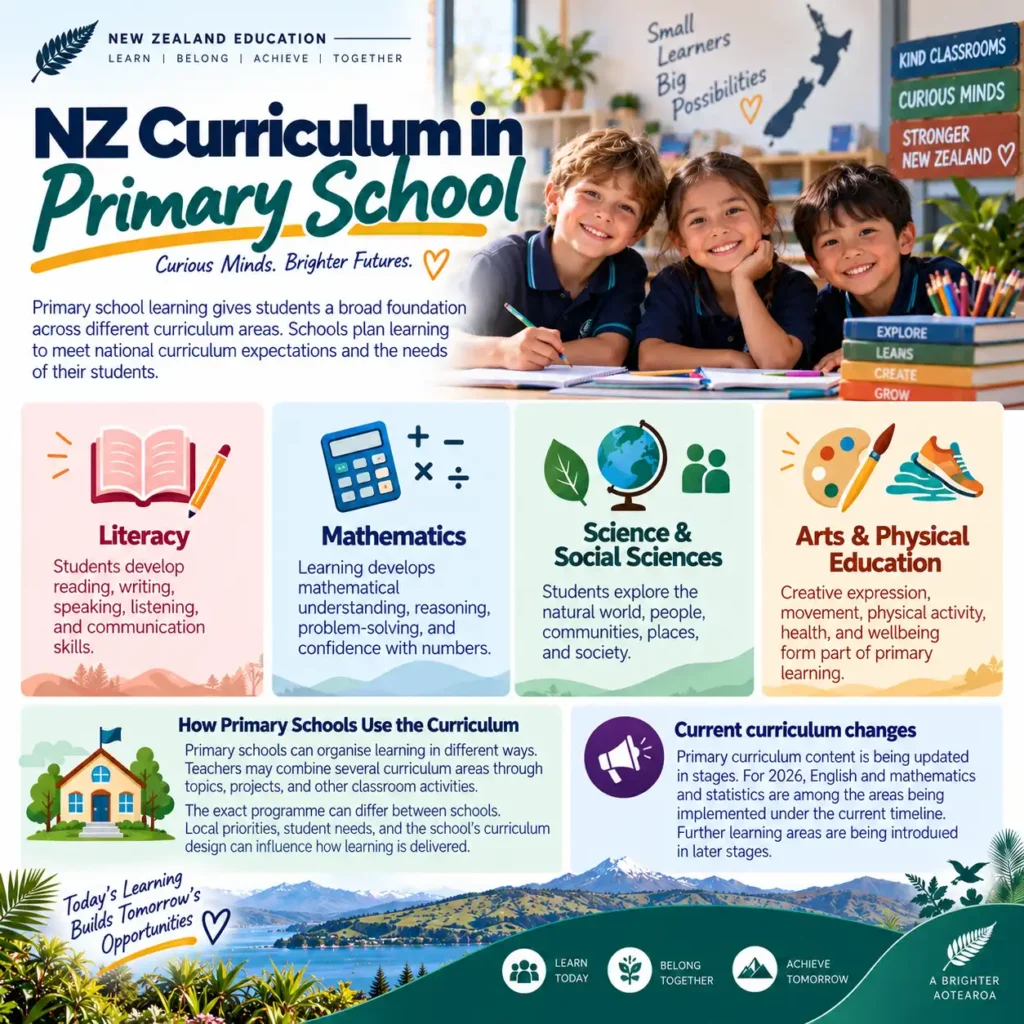
NZ Curriculum in Primary School
Primary school learning gives students a broad foundation across different curriculum areas. Schools plan learning to meet national curriculum expectations and the needs of their students.
Literacy
Students develop reading, writing, speaking, listening, and communication skills.
Mathematics
Learning develops mathematical understanding, reasoning, problem-solving, and confidence with numbers.
Science & Social Sciences
Students explore the natural world, people, communities, places, and society.
Arts & Physical Education
Creative expression, movement, physical activity, health, and wellbeing form part of primary learning.
How Primary Schools Use the Curriculum
Primary schools can organise learning in different ways. Teachers may combine several curriculum areas through topics, projects, and other classroom activities.
The exact programme can differ between schools. Local priorities, student needs, and the school’s curriculum design can influence how learning is delivered.
Primary curriculum content is being updated in stages. For 2026, English and mathematics and statistics are among the areas being implemented under the current timeline. Further learning areas are being introduced in later stages.
NZ Curriculum in Secondary School
Secondary school students continue building core knowledge while developing deeper subject understanding. Learning becomes more specialised as students move through the senior years.
Core Learning
Students continue learning important areas such as English, mathematics and statistics, science, and social sciences.
Subject Choices
As students progress, schools may offer a wider range of subjects and courses based on their interests and future plans.
Practical Learning
Technology, the arts, health, physical education, and other areas can provide practical and creative learning opportunities.
Senior Learning
Senior students work towards qualifications and learning pathways that can support further study, training, or employment.
How Curriculum Changes Through Secondary School
| Stage | Main Focus |
|---|---|
| Years 9–10 | Broad learning across curriculum areas with increasing subject depth. |
| Years 11–13 | More specialised study, qualifications, and pathways towards future education, training, or work. |
New senior qualifications are being introduced in stages. The Foundational Award is planned for Year 11 in 2028, followed by the New Zealand Certificate of Education in Year 12 in 2029 and the Advanced New Zealand Certificate of Education in Year 13 in 2030.
Note: Subject availability and course structures can differ between secondary schools. Check the individual school’s current curriculum and subject information.
Māori-Medium Curriculum in New Zealand
Māori-medium education provides learning where te reo Māori is the main language of instruction. It follows a different national curriculum framework from the English-medium New Zealand Curriculum.
Te Marautanga o Aotearoa
Te Marautanga o Aotearoa is the national curriculum framework for Māori-medium education.
Te Reo Māori
Learning through te reo Māori supports language development while students work across different areas of the curriculum.
Māori Perspectives
The framework reflects Māori knowledge, values, language, culture, and perspectives across learning.
English-Medium vs Māori-Medium Curriculum
| Area | English-Medium | Māori-Medium |
|---|---|---|
| Curriculum framework | New Zealand Curriculum | Te Marautanga o Aotearoa |
| Main language | English | Te reo Māori |
Māori-medium education is part of New Zealand’s wider education system. The curriculum framework, language, and learning approach can differ from English-medium schooling.
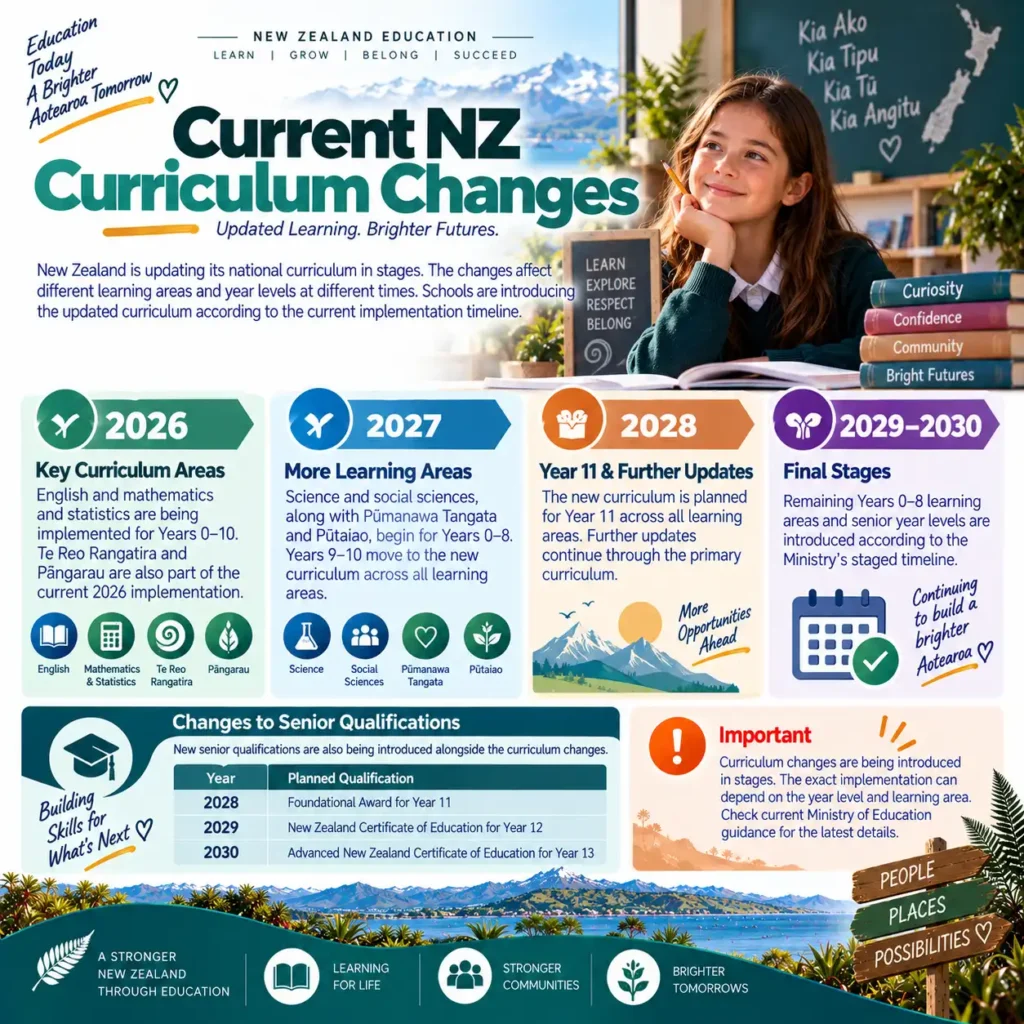
Current NZ Curriculum Changes
New Zealand is updating its national curriculum in stages. The changes affect different learning areas and year levels at different times. Schools are introducing the updated curriculum according to the current implementation timeline.
Key Curriculum Areas
English and mathematics and statistics are being implemented for Years 0–10. Te Reo Rangatira and Pāngarau are also part of the current 2026 implementation.
More Learning Areas
Science and social sciences, along with Pūmanawa Tangata and Pūtaiao, begin for Years 0–8. Years 9–10 move to the new curriculum across all learning areas.
Year 11 & Further Updates
The new curriculum is planned for Year 11 across all learning areas. Further updates continue through the primary curriculum.
Final Stages
Remaining Years 0–8 learning areas and senior year levels are introduced according to the Ministry’s staged timeline.
Changes to Senior Qualifications
New senior qualifications are also being introduced alongside the curriculum changes.
| Year | Planned Qualification |
|---|---|
| 2028 | Foundational Award for Year 11 |
| 2029 | New Zealand Certificate of Education for Year 12 |
| 2030 | Advanced New Zealand Certificate of Education for Year 13 |
Curriculum changes are being introduced in stages. The exact implementation can depend on the year level and learning area. Check current Ministry of Education guidance for the latest details.
How NZ Schools Deliver the Curriculum
The national curriculum provides a framework for learning, but schools have flexibility in how they design and deliver their programmes. This allows learning to reflect students, communities, and local needs.
School Curriculum Design
Each school develops its own local curriculum within the national curriculum framework.
Local Context
Schools can reflect their local community, environment, culture, and the interests and needs of their students.
Connected Learning
Teachers can connect learning areas through topics, projects, activities, and real-world contexts.
Student Needs
Teaching can be adapted to support different students and help them make progress in their learning.
National Framework and Local Curriculum
The national curriculum sets the direction for learning. Schools then make decisions about how that learning is organised and taught.
This means two schools can teach the same curriculum areas while using different topics, resources, activities, and teaching approaches.
If you want to know exactly what your child will learn, check the school’s local curriculum or contact the school directly. The national framework does not describe every classroom activity or school programme.
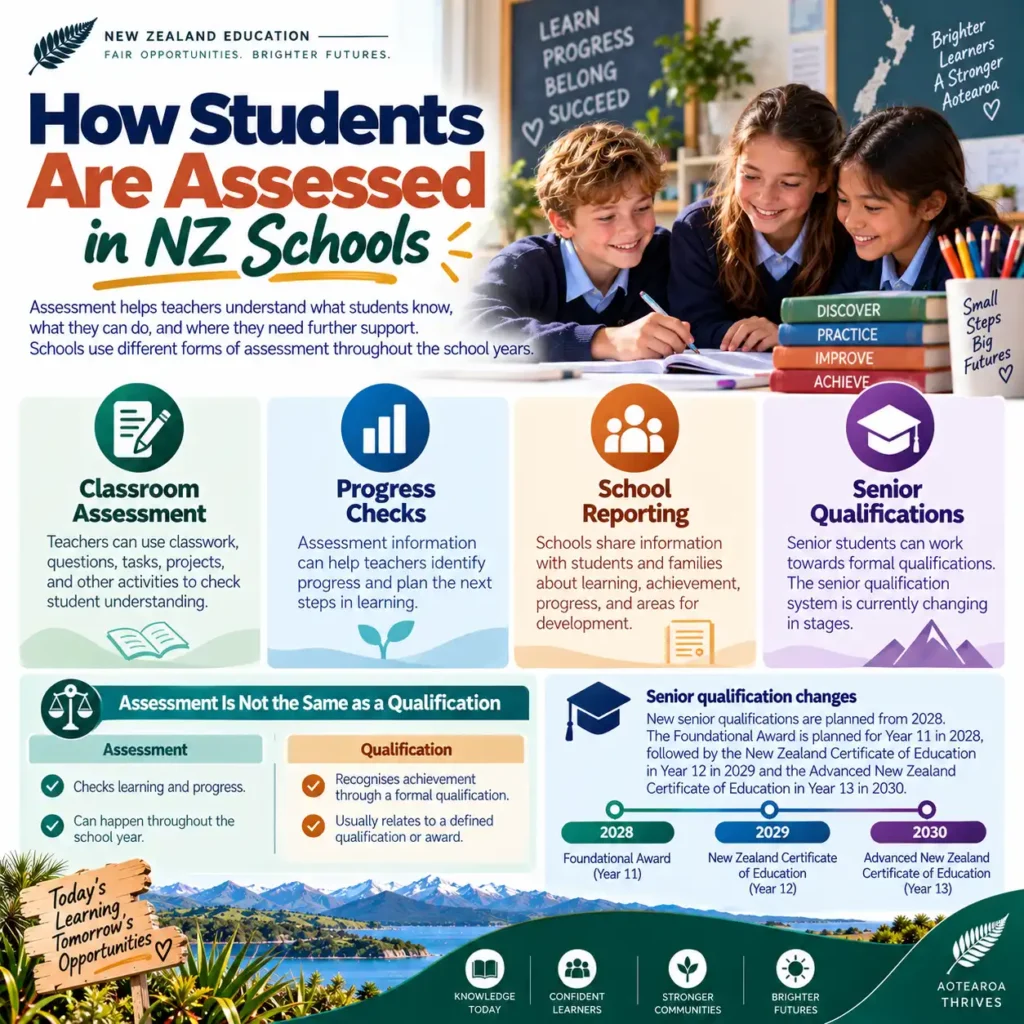
How Students Are Assessed in NZ Schools
Assessment helps teachers understand what students know, what they can do, and where they need further support. Schools use different forms of assessment throughout the school years.
Classroom Assessment
Teachers can use classwork, questions, tasks, projects, and other activities to check student understanding.
Progress Checks
Assessment information can help teachers identify progress and plan the next steps in learning.
School Reporting
Schools share information with students and families about learning, achievement, progress, and areas for development.
Senior Qualifications
Senior students can work towards formal qualifications. The senior qualification system is currently changing in stages.
Assessment Is Not the Same as a Qualification
| Assessment | Qualification |
|---|---|
| Checks learning and progress. | Recognises achievement through a formal qualification. |
| Can happen throughout the school year. | Usually relates to a defined qualification or award. |
New senior qualifications are planned from 2028. The Foundational Award is planned for Year 11 in 2028, followed by the New Zealand Certificate of Education in Year 12 in 2029 and the Advanced New Zealand Certificate of Education in Year 13 in 2030.
Note: Assessment methods can differ between schools, subjects, and year levels. Check your school’s current assessment information for specific details.
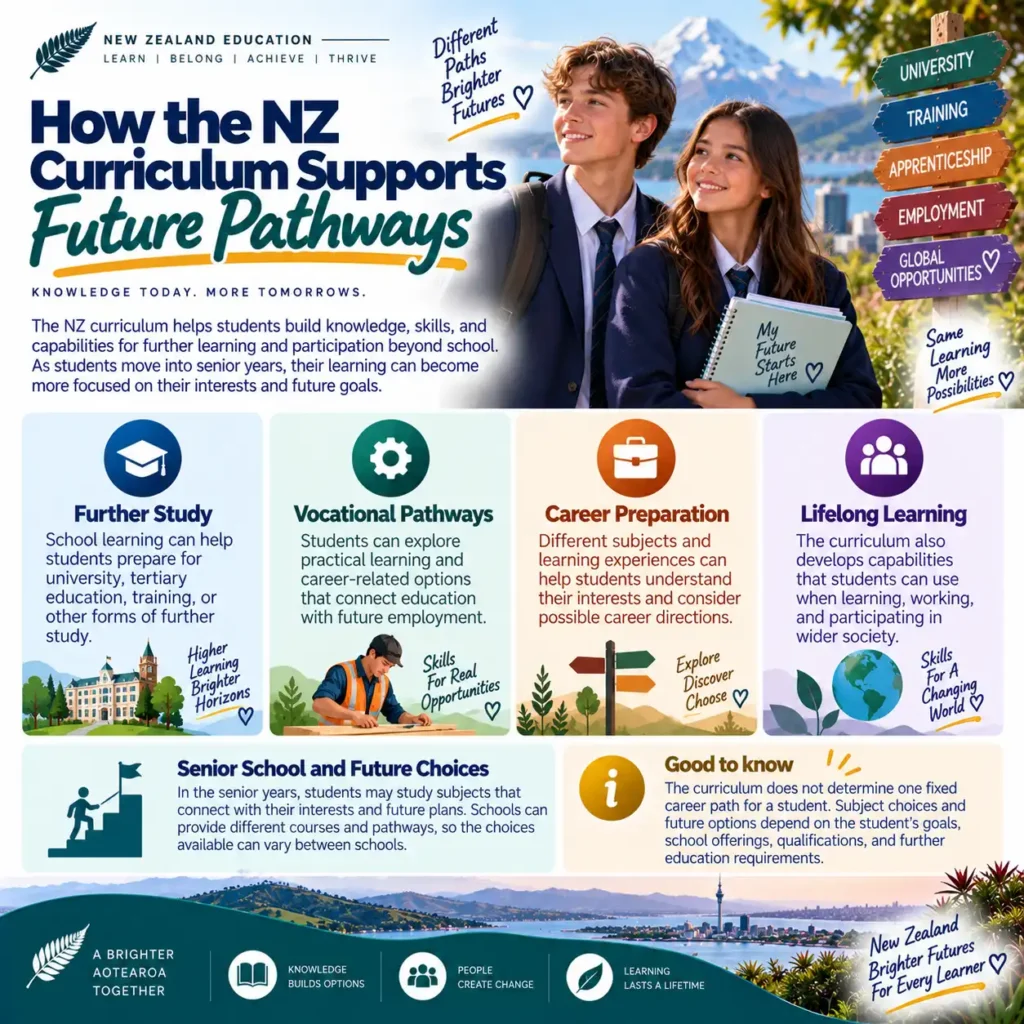
How the NZ Curriculum Supports Future Pathways
The NZ curriculum helps students build knowledge, skills, and capabilities for further learning and participation beyond school. As students move into senior years, their learning can become more focused on their interests and future goals.
Further Study
School learning can help students prepare for university, tertiary education, training, or other forms of further study.
Vocational Pathways
Students can explore practical learning and career-related options that connect education with future employment.
Career Preparation
Different subjects and learning experiences can help students understand their interests and consider possible career directions.
Lifelong Learning
The curriculum also develops capabilities that students can use when learning, working, and participating in wider society.
Senior School and Future Choices
In the senior years, students may study subjects that connect with their interests and future plans. Schools can provide different courses and pathways, so the choices available can vary between schools.
The curriculum does not determine one fixed career path for a student. Subject choices and future options depend on the student’s goals, school offerings, qualifications, and further education requirements.
FAQs About the NZ School Curriculum
These answers cover common questions about the New Zealand Curriculum, school subjects, learning areas, and current curriculum changes.
Curriculum requirements are changing over several years. Always check current Ministry of Education guidance for the latest implementation dates.
Official Sources for the NZ School Curriculum
The following official New Zealand education sources provide information about the curriculum, learning areas, Māori-medium education, and current curriculum changes.
New Zealand Curriculum
Official curriculum information, content, and resources for New Zealand schools.
Visit Tahurangi →Changes to the NZ Curriculum
Ministry of Education information about the current national curriculum changes and implementation programme.
Visit Education.govt.nz →Te Marautanga o Aotearoa
Official curriculum information for Māori-medium education in Aotearoa New Zealand.
View Curriculum →Curriculum Implementation Timeline
Ministry updates on the staged implementation of the refreshed national curriculum.
Read Ministry Update →New Senior Qualifications
Ministry information about the new qualifications being introduced for Years 11–13.
Visit Education.govt.nz →Curriculum content and implementation dates are changing in stages. Use the Ministry of Education’s latest information when checking requirements for a specific year level or learning area.