

Table of Contents
Jump to any section to quickly find information about NZ school years, year levels, ages and school stages.
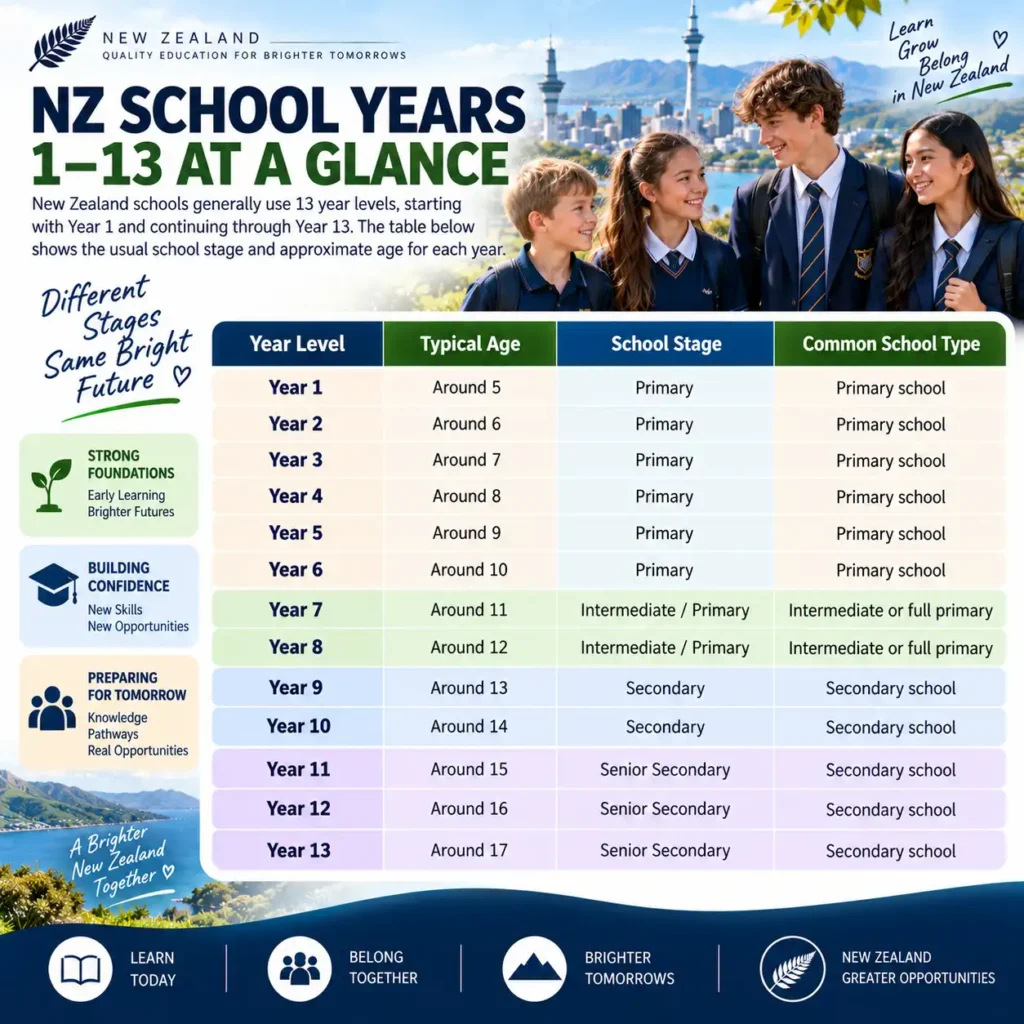
NZ School Years 1–13 at a Glance
New Zealand schools generally use 13 year levels, starting with Year 1 and continuing through Year 13. The table below shows the usual school stage and approximate age for each year.
| Year Level | Typical Age | School Stage | Common School Type |
|---|---|---|---|
| Year 1 | Around 5 | Primary | Primary school |
| Year 2 | Around 6 | Primary | Primary school |
| Year 3 | Around 7 | Primary | Primary school |
| Year 4 | Around 8 | Primary | Primary school |
| Year 5 | Around 9 | Primary | Primary school |
| Year 6 | Around 10 | Primary | Primary school |
| Year 7 | Around 11 | Intermediate / Primary | Intermediate or full primary |
| Year 8 | Around 12 | Intermediate / Primary | Intermediate or full primary |
| Year 9 | Around 13 | Secondary | Secondary school |
| Year 10 | Around 14 | Secondary | Secondary school |
| Year 11 | Around 15 | Senior Secondary | Secondary school |
| Year 12 | Around 16 | Senior Secondary | Secondary school |
| Year 13 | Around 17 | Senior Secondary | Secondary school |
School Stages in New Zealand
The NZ school system is commonly divided into primary and secondary education. Depending on the school, Years 7 and 8 may be taught at an intermediate school or a full primary school.
Primary School
Primary education provides the foundation for students’ learning. Some primary schools finish at Year 6, while full primary schools continue through Year 8.
Intermediate School
Intermediate schools provide a separate setting for Years 7 and 8. They are not used in every part of New Zealand.
Secondary School
Secondary education covers the later school years and prepares students for further study, training, employment, and other pathways.
How the School Stages Connect
Year 1 to Year 6 in New Zealand
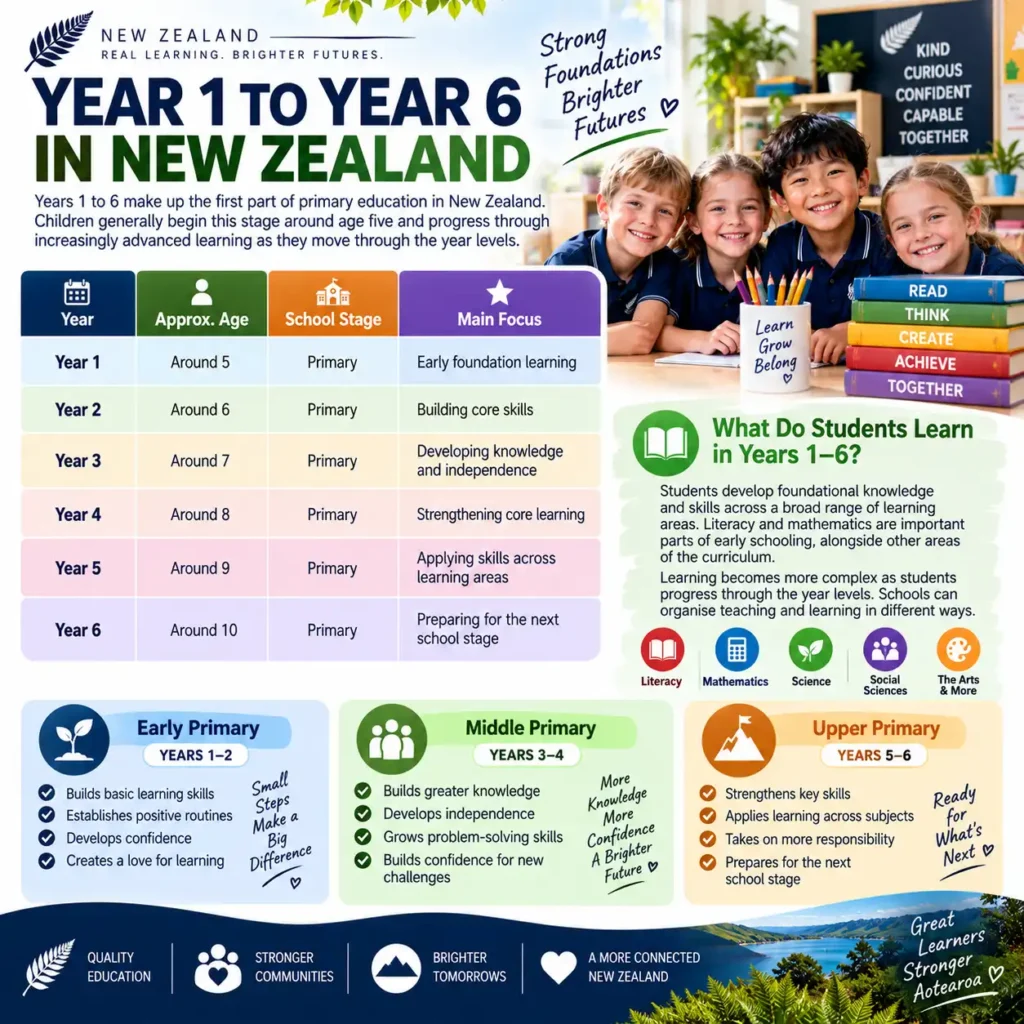
Years 1 to 6 make up the first part of primary education in New Zealand. Children generally begin this stage around age five and progress through increasingly advanced learning as they move through the year levels.
| Year | Approx. Age | School Stage | Main Focus |
|---|---|---|---|
| Year 1 | Around 5 | Primary | Early foundation learning |
| Year 2 | Around 6 | Primary | Building core skills |
| Year 3 | Around 7 | Primary | Developing knowledge and independence |
| Year 4 | Around 8 | Primary | Strengthening core learning |
| Year 5 | Around 9 | Primary | Applying skills across learning areas |
| Year 6 | Around 10 | Primary | Preparing for the next school stage |
What Do Students Learn in Years 1–6?
Students develop foundational knowledge and skills across a broad range of learning areas. Literacy and mathematics are important parts of early schooling, alongside other areas of the curriculum.
Learning becomes more complex as students progress through the year levels. Schools can organise teaching and learning in different ways.
Years 1–2 focus strongly on establishing basic learning skills and routines.
Years 3–4 build greater knowledge, confidence, and independence.
Years 5–6 strengthen skills and help students prepare for later schooling.
Year 7 and Year 8 in New Zealand
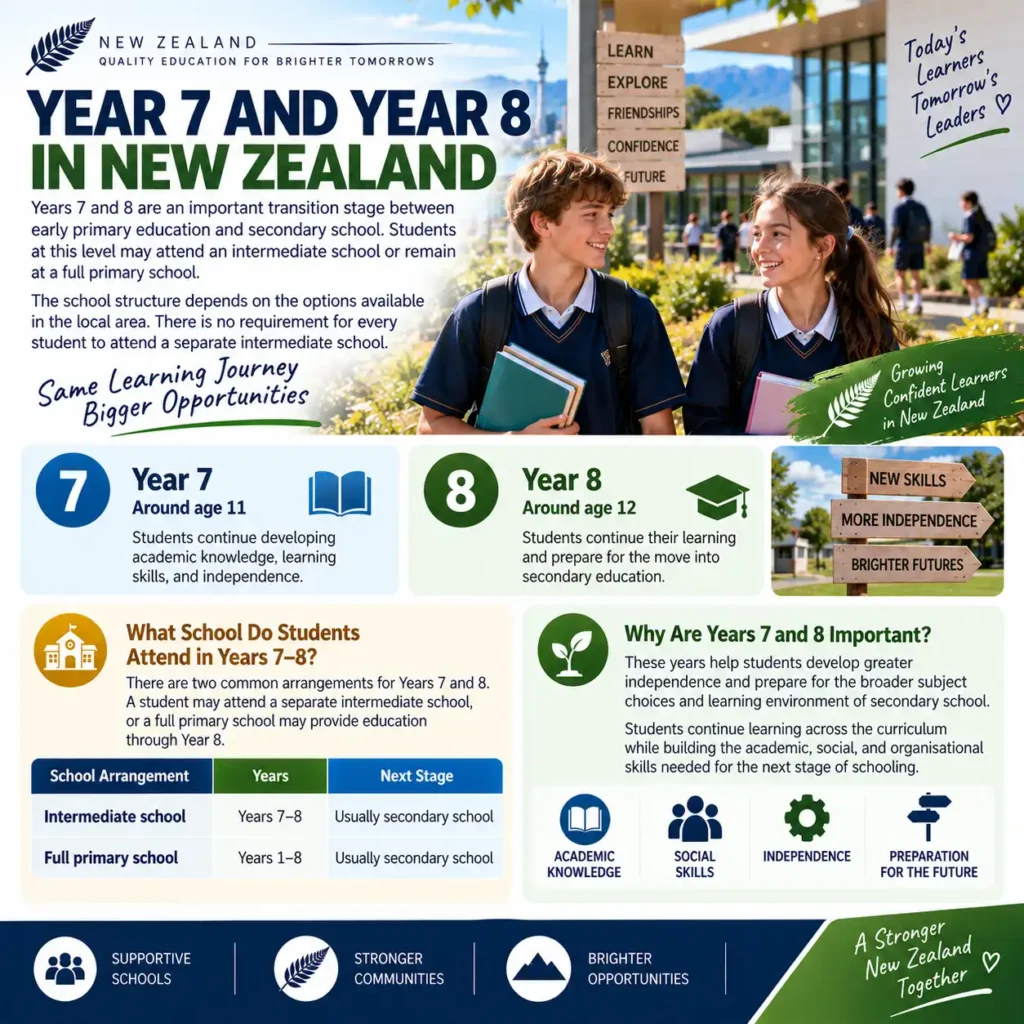
Years 7 and 8 are an important transition stage between early primary education and secondary school. Students at this level may attend an intermediate school or remain at a full primary school.
The school structure depends on the options available in the local area. There is no requirement for every student to attend a separate intermediate school.
Year 7
Students continue developing academic knowledge, learning skills, and independence.
Year 8
Students continue their learning and prepare for the move into secondary education.
What School Do Students Attend in Years 7–8?
There are two common arrangements for Years 7 and 8. A student may attend a separate intermediate school, or a full primary school may provide education through Year 8.
| School Arrangement | Years | Next Stage |
|---|---|---|
| Intermediate school | Years 7–8 | Usually secondary school |
| Full primary school | Years 1–8 | Usually secondary school |
Why Are Years 7 and 8 Important?
These years help students develop greater independence and prepare for the broader subject choices and learning environment of secondary school.
Students continue learning across the curriculum while building the academic, social, and organisational skills needed for the next stage of schooling.
Year 9 to Year 13 in New Zealand
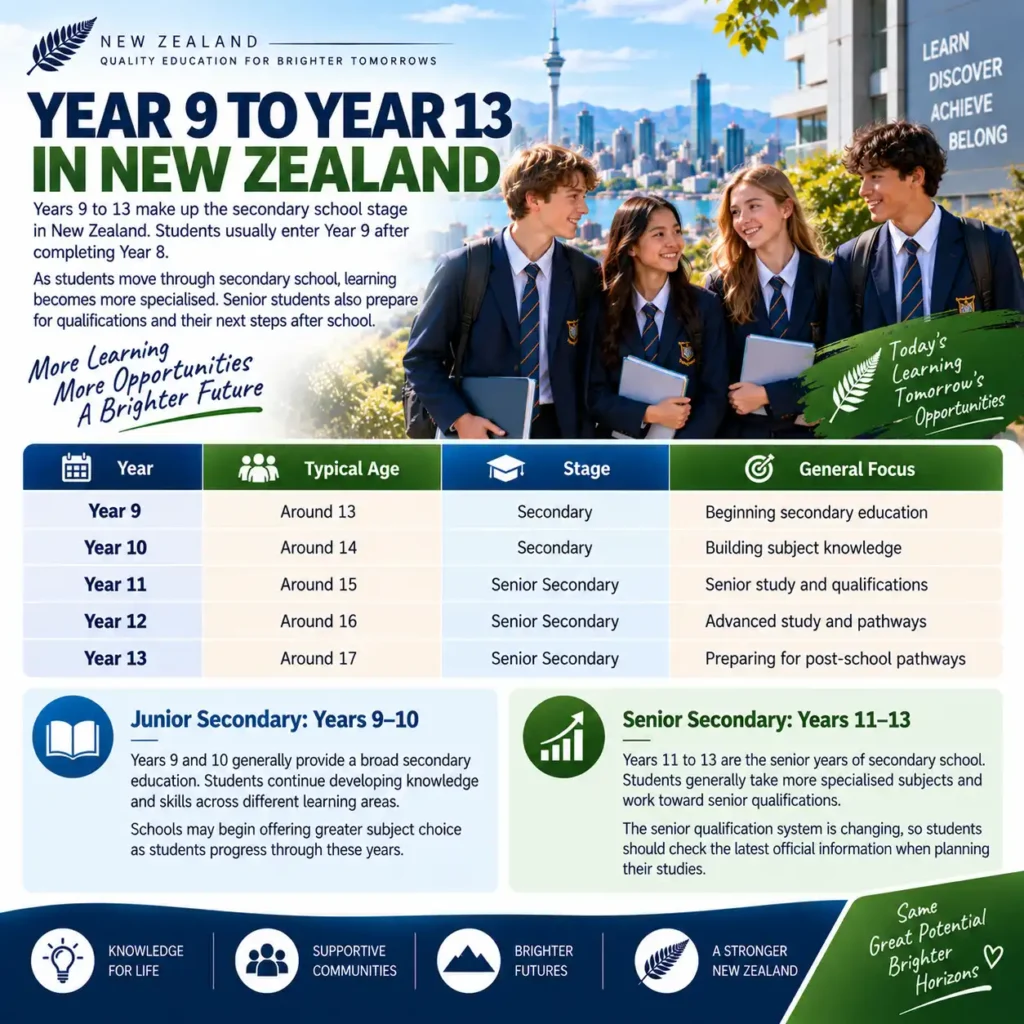
Years 9 to 13 make up the secondary school stage in New Zealand. Students usually enter Year 9 after completing Year 8.
As students move through secondary school, learning becomes more specialised. Senior students also prepare for qualifications and their next steps after school.
| Year | Typical Age | Stage | General Focus |
|---|---|---|---|
| Year 9 | Around 13 | Secondary | Beginning secondary education |
| Year 10 | Around 14 | Secondary | Building subject knowledge |
| Year 11 | Around 15 | Senior Secondary | Senior study and qualifications |
| Year 12 | Around 16 | Senior Secondary | Advanced study and pathways |
| Year 13 | Around 17 | Senior Secondary | Preparing for post-school pathways |
Junior Secondary: Years 9–10
Years 9 and 10 generally provide a broad secondary education. Students continue developing knowledge and skills across different learning areas.
Schools may begin offering greater subject choice as students progress through these years.
Senior Secondary: Years 11–13
Years 11 to 13 are the senior years of secondary school. Students generally take more specialised subjects and work toward senior qualifications.
The senior qualification system is changing, so students should check the latest official information when planning their studies.
NZ School Years by Age
A child’s school year in New Zealand usually relates to their age, but the exact age can vary. School entry dates and individual circumstances can affect which year level a student is in.
| School Year | Typical Age | School Stage |
|---|---|---|
| Year 1 | Around 5 | Primary |
| Year 2 | Around 6 | Primary |
| Year 3 | Around 7 | Primary |
| Year 4 | Around 8 | Primary |
| Year 5 | Around 9 | Primary |
| Year 6 | Around 10 | Primary |
| Year 7 | Around 11 | Intermediate / Primary |
| Year 8 | Around 12 | Intermediate / Primary |
| Year 9 | Around 13 | Secondary |
| Year 10 | Around 14 | Secondary |
| Year 11 | Around 15 | Senior Secondary |
| Year 12 | Around 16 | Senior Secondary |
| Year 13 | Around 17 | Senior Secondary |
Do NZ School Years Match a Child’s Age Exactly?
Not always. The ages in the table are a general guide rather than fixed age requirements for every year level.
Children may start school at different times, and some schools use cohort entry. For this reason, the age of students within a particular year level can vary.
How Students Move Between NZ School Years
Students normally progress through the NZ school years from Year 1 to Year 13. The school they attend can change as they move from one stage to another.
The transition points are not identical for every student because schools have different structures. Years 7 and 8 are the clearest example, as they may be taught at an intermediate or full primary school.
Starting School
Children can generally start school from age five and enter Year 1 or another appropriate new-entrant level.
Years 7–8
Students may move to an intermediate school or remain at a full primary school.
Year 9
Students generally begin secondary school after completing Year 8.
From Primary to Secondary School
A common pathway is primary education through Year 6, intermediate school in Years 7 and 8, and secondary school from Year 9.
Another pathway is a full primary school from Year 1 through Year 8, followed by secondary school from Year 9.
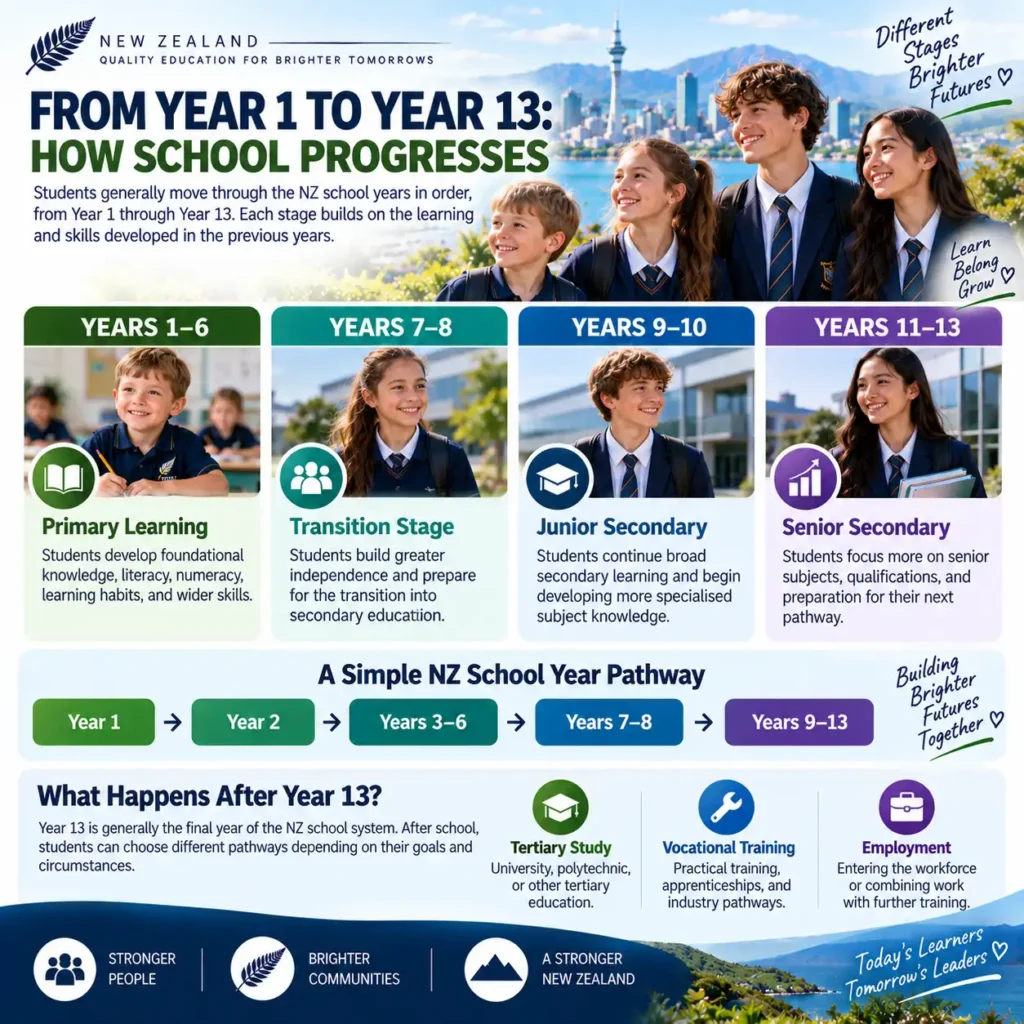
From Year 1 to Year 13: How School Progresses
Students generally move through the NZ school years in order, from Year 1 through Year 13. Each stage builds on the learning and skills developed in the previous years.
Primary Learning
Students develop foundational knowledge, literacy, numeracy, learning habits, and wider skills.
Transition Stage
Students build greater independence and prepare for the transition into secondary education.
Junior Secondary
Students continue broad secondary learning and begin developing more specialised subject knowledge.
Senior Secondary
Students focus more on senior subjects, qualifications, and preparation for their next pathway.
A Simple NZ School Year Pathway
What Happens After Year 13?
Year 13 is generally the final year of the NZ school system. After school, students can choose different pathways depending on their goals and circumstances.
University, polytechnic, or other tertiary education.
Practical training, apprenticeships, and industry pathways.
Entering the workforce or combining work with further training.
Year 11, Year 12 and Year 13 in New Zealand
Years 11 to 13 are the senior years of secondary school in New Zealand. Students usually become more focused on qualifications, subject choices, future study, training and careers during this stage.
Around age 15
Students continue senior secondary education and work toward qualifications suited to their learning pathway.
Around age 16
Students generally continue with more advanced subjects and prepare for further education, training or employment.
Around age 17
This is normally the final school year before students move into university, tertiary study, training, work or another pathway.
What happens after Year 13?
After Year 13, students can choose different pathways depending on their goals and qualifications. Options can include university, polytechnic or other tertiary education, vocational training, apprenticeships, employment, or further career-focused study.
FAQs About NZ School Years 1–13
Here are answers to common questions about New Zealand school year levels, ages and the progression from Year 1 to Year 13.
How many school years are there in New Zealand?
The New Zealand school system has 13 year levels, from Year 1 through Year 13. Primary education generally covers Years 1–8, while secondary education covers Years 9–13.
What age is Year 1 in New Zealand?
Year 1 students are generally around 5 years old. The exact age can vary because children may start school at different times under the school’s entry arrangements.
What age is Year 8 in New Zealand?
Year 8 students are usually around 12 years old. Year 8 can be the final year of a full primary school or part of an intermediate school.
What age is Year 9 in New Zealand?
Year 9 students are typically around 13 years old. Year 9 is normally the first year of secondary school.
What age is Year 13 in New Zealand?
Year 13 students are generally around 17 years old. It is usually the final year of secondary school in New Zealand.
Are Years 7 and 8 always in intermediate school?
No. Some students attend an intermediate school for Years 7 and 8, while others remain at a full primary school through Year 8.
When do children start school in New Zealand?
Children can generally start school from age 5. Schools may use different entry arrangements, including individual start dates or cohort entry.
Is Year 11, Year 12 or Year 13 compulsory?
Schooling is compulsory in New Zealand from ages 6 to 16. Students may therefore have different education or training arrangements depending on their age and circumstances.
Do all New Zealand schools use the same year-level structure?
No. The 13 year levels are part of the national school system, but schools can organise their students differently. For example, some schools cover Years 1–8 as a full primary school, while others have separate intermediate and secondary stages.
Official Sources for NZ School Years
The information on this page is based on official New Zealand education sources. These sources provide current information about school year levels, starting ages, school structures and education pathways.
NZ School Years 1–13: Final Takeaway
New Zealand schools use 13 year levels, beginning with Year 1 and continuing through Year 13. Students are generally around 5 years old in Year 1 and around 17 in Year 13.
Years 1–8 cover primary education, while Years 9–13 are secondary education. Years 7 and 8 may be taught at an intermediate school or within a full primary school, depending on the school’s structure.